
Is AI Killing Your Business? Why 95%+ Tracking Accuracy Is Now Essential
If your website traffic, leads, or sales are falling, the fear is understandable: buyers are asking Google AI Overviews, ChatGPT, Claude, Gemini, Copilot, and Perplexity for answers that used to require a visit to your website. Some of those buyers never click. Others discover your company inside an AI answer, then return later through a branded search, a direct visit, or a different device.
That does not automatically mean AI is killing your business. It means the old relationship between search visibility, website traffic, and measurable demand is breaking apart.
After more than 15 years working on tracking systems, I would not tell a worried owner to ignore AI. I would tell them something more urgent:
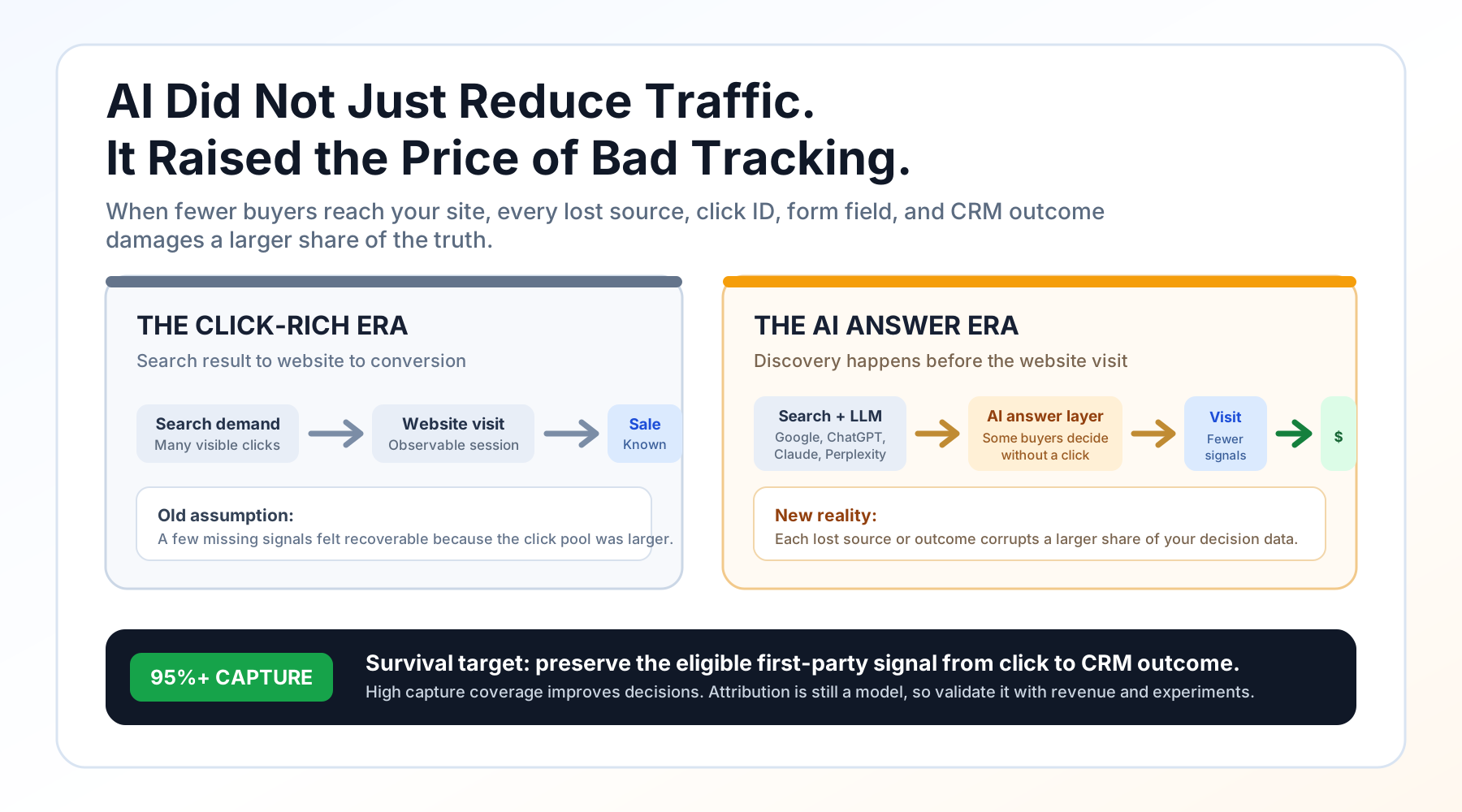
When the observable signal gets smaller, losing another 5%, 10%, or 20% to broken tracking is no longer acceptable. Your remaining first-party data has to be exceptionally clean. High-90s capture coverage is becoming a business survival requirement.
If it feels like your business is disappearing
- Organic impressions still exist, but clicks and click-through rate are falling.
- Website sessions are down, yet you cannot tell whether demand disappeared or buyers moved into AI answers and zero-click journeys.
- ChatGPT or Perplexity sends a small number of visitors, but the CRM labels many conversions as direct, unknown, or unassigned.
- Your forms receive leads, but UTMs, click IDs, landing pages, and referrers are missing.
- Meta and Google optimize from a smaller conversion pool, and part of that pool contains duplicates, low-quality leads, bots, or incomplete match data.
- Paid media reports conversions, while sales says the qualified lead and revenue numbers do not match.
- Teams are preparing to cut SEO, content, or advertising without first proving whether the problem is demand loss, traffic interception, tracking loss, or all three.
Do not make a survival decision from a dashboard that may be missing the very signals needed to explain the decline.
The short answer
AI is reducing the number of observable clicks for many informational journeys, but tracking failure can make the decline look worse and train advertising systems on the wrong outcomes. Before cutting a channel, aim to preserve at least 95% of eligible first-party acquisition and conversion signals from the landing page through the form, CRM, revenue record, and ad-platform feedback loop.
That does not mean you can know the true cause of every sale with 95% certainty. Attribution is still a model. The high-90s target applies to the data you are technically and legally eligible to observe:
- Did the UTM or click ID that arrived on the landing page reach the lead or order?
- Did the form submission reach the CRM?
- Did the CRM preserve the first-touch and last-touch context?
- Did qualified status, revenue, and customer value flow back to the right platform?
- Did browser and server events deduplicate correctly?
- Can finance, CRM, analytics, and ad-platform totals be reconciled within a known tolerance?
Do not confuse tracking coverage with attribution certainty. A perfect database cannot directly observe every zero-click AI influence, private conversation, word-of-mouth recommendation, or cross-device journey. The goal is to eliminate avoidable technical loss, label what remains unknown, and validate attribution with revenue reconciliation and experiments.
Why AI search traffic loss feels like a business crisis
The older search model was easier to observe. A person searched Google or Bing, clicked a result, reached a landing page, and converted. The journey was never perfectly clean, but the click created a recognizable handoff between the search engine and your website.
AI search inserts an answer layer before the visit:
Question
   -> AI summary, recommendation, or comparison
      -> no click, citation click, branded search, or delayed direct visit
         -> website
            -> lead, order, booking, or no action
Pew Research Center analyzed 68,879 Google searches from March 2025. When an AI summary appeared, users clicked a traditional result in 8% of visits, compared with 15% when no AI summary appeared. A source inside the AI summary received a click in only 1% of visits. In a February 2026 survey, 60% of U.S. adults said they ever read AI summaries at the top of search results.
Ahrefs separately reported that the presence of an AI Overview correlated with a substantially lower click-through rate for the top organic result. Its updated 2026 analysis estimated the gap at roughly 58%. That is a third-party correlation study, not proof that every site's decline was caused by AI, but it matches the customer symptom: rankings or impressions can remain visible while fewer people reach the website.
Google takes a more positive view and says clicks from AI features can be higher quality. Google also says AI Overview and AI Mode activity is included in Search Console reporting and has begun testing dedicated generative-AI visibility reports.
Both ideas can be true at once:
- AI answers can reduce total clicks.
- The people who still click may be more informed and more valuable.
That is exactly why tracking quality matters more. If the remaining click pool is smaller but more qualified, you cannot afford to lose its source before the conversion reaches your CRM.
Do not blame AI until you separate four different failures
A traffic decline can come from several places. Treating every decline as an AI problem can be as dangerous as ignoring AI completely.
| What changed | What it may mean | What to check next |
|---|---|---|
| Impressions are stable, average position is stable, but organic CTR falls | AI Overviews, answer features, or a changed search result may be intercepting clicks | Segment by query and page; compare AI-feature visibility where available; inspect the live SERP |
| Impressions and rankings fall together | Technical SEO, indexing, content quality, competition, seasonality, or demand may have changed | Search Console Pages and Queries reports, indexing, canonicals, manual actions, Trends, competitor movement |
| Analytics sessions fall, but forms, orders, or CRM records remain stable | Analytics collection may be failing, consent behavior changed, or higher-intent traffic may be converting better | Server logs, form database, ecommerce orders, CRM totals, consent mode, tag diagnostics |
| Forms show submissions, but CRM leads fall | The form-to-CRM integration or field mapping is broken | Webhook logs, connector errors, automation history, duplicate/merge rules |
| CRM revenue is stable, but channel attribution becomes direct or unknown | Source persistence, cross-domain tracking, cookies, redirects, or hidden fields may be failing | First-touch fields, last-touch fields, landing page, referrer, UTMs, click IDs |
| Ad-platform conversions rise while qualified sales fall | The platform may be optimizing toward a weak, duplicated, or bot-triggered event | Event definition, deduplication, lead-quality feedback, offline conversions, bot filtering |
| AI referrals rise, but CRM never shows AI as a source | Referrer classification or form capture is incomplete | AI source rules, original referrer storage, hidden fields, CRM channel mapping |
Google's own traffic-drop documentation recommends checking technical issues, security issues, algorithmic changes, seasonality, reporting problems, and changing search interest. AI is now part of the diagnosis, not a substitute for diagnosis.
What 95%+ tracking accuracy should mean
"Our tracking is 95% accurate" is usually too vague to be useful. Start by defining the denominator and the handoff.
1. Eligible signal capture
If a landing session arrives with utm_source, gclid, fbclid, msclkid, a recognized AI referrer, or another permitted acquisition signal, measure how often that exact signal survives to the relevant lead, order, or booking.
Eligible source capture coverage =
conversion records preserving the observed landing signal
---------------------------------------------------------
conversion records whose landing session had that signal
Do not divide by all traffic. Organic, direct, returning, and privacy-restricted sessions will not always have a click ID or UTM parameter.
2. Form and order completeness
Measure the percentage of real submissions or orders that contain the required attribution fields. Use separate rates for:
- first landing page;
- original referrer;
- first-touch source, medium, campaign, term, and content;
- last-touch source, medium, campaign, term, and content;
gclid,gbraid,wbraid,fbclid,fbc,fbp, andmsclkidwhen present and permitted;- form, checkout, or booking page;
- conversion timestamp and unique event ID;
- consent state or legal basis where required.
3. CRM delivery and field mapping
A perfect browser record is worthless if the CRM integration drops the fields. Reconcile:
- successful form submissions against created CRM records;
- source fields against mapped CRM properties;
- merged leads against preserved original-source fields;
- opportunities and purchases against the originating contact or lead;
- CRM outcomes against imported offline conversion events.
4. Event delivery, deduplication, and freshness
For browser and server events, monitor:
- event delivery success;
- matching event name and
event_idon both sides; - duplicate rate;
- event time and delivery delay;
- required value, currency, product, and order fields;
- match-data coverage that complies with platform policy;
- invalid, blocked, malformed, or stale events.
5. Revenue reconciliation
Analytics, Meta, Google Ads, and your CRM will not always report identical numbers because attribution windows and models differ. But the variance should be known, explainable, and stable.
Your finance or order system is the authority for booked revenue. Your CRM is the authority for lead status and sales progression. Analytics explains website behavior. Ad platforms explain what their optimization systems received and attributed.
A strong tracking system does not force every dashboard to match. It explains why they do not match.
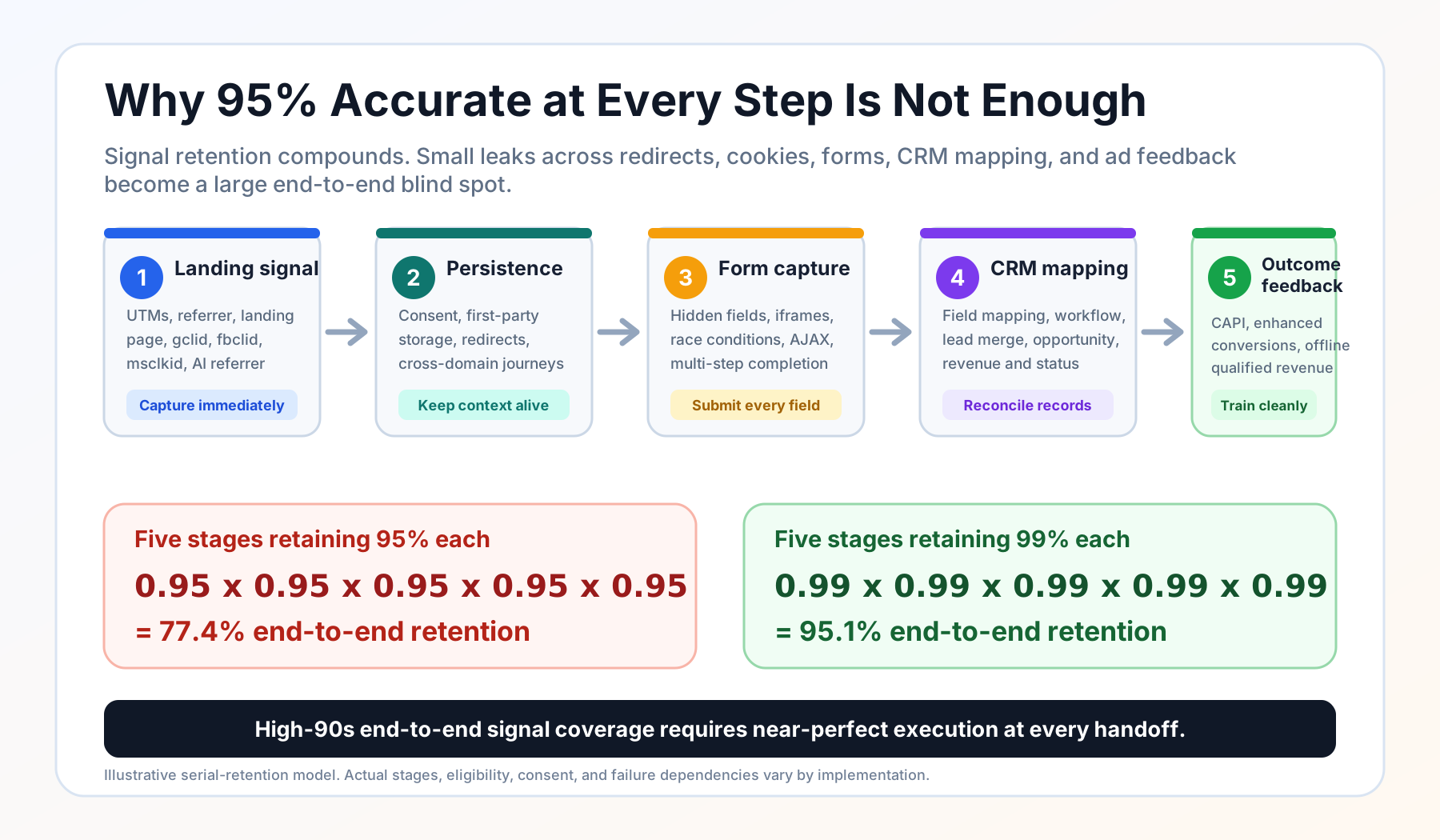
The compounding math most teams miss
Suppose your customer journey has five tracking handoffs:
- Landing-page signal capture
- Cookie or first-party persistence
- Form or checkout submission
- CRM field mapping
- Qualified conversion feedback to the ad platform
If each handoff preserves 95% of its input, the end-to-end retention is not 95%.
0.95 x 0.95 x 0.95 x 0.95 x 0.95 = 77.4%
If every handoff preserves 99%, the end-to-end result is about 95.1%.
0.99 x 0.99 x 0.99 x 0.99 x 0.99 = 95.1%
This is an illustrative serial pipeline, and real failures are not always independent. But the lesson holds: high-90s end-to-end coverage requires near-perfect execution at every handoff.
Why weak signals are more dangerous when volume falls
Advertising algorithms learn from the conversion events you send. When there are many genuine conversions, a few bad records may be diluted by a larger pool. When visible demand and conversion volume decline, each bad event carries more weight.
Imagine a campaign receives only 100 optimization events this month:
- 12 are duplicates because browser and server events did not deduplicate;
- 8 are bots or accidental form submissions;
- 10 are low-quality leads that sales rejected;
- 15 genuine qualified outcomes never flowed back from the CRM.
The platform does not see your business reality. It sees the event stream you gave it.
You are not merely undercounting conversions. You may be teaching the algorithm that duplicated, automated, or low-value behavior is the behavior it should find more often.
This is why signal quality must include the full outcome:
- not only
Lead, but QualifiedLead; - not only
Schedule, but AppointmentHeld; - not only
Purchase, but correct value, currency, order ID, and margin context where supported; - not only a browser event, but a deduplicated browser and server event pair;
- not only a campaign click, but the later CRM status and revenue result.
Meta describes Conversions API as a more reliable connection between website, server, CRM, app, messaging, and offline data and its optimization systems. Google says enhanced conversions can improve measurement accuracy by using permitted, hashed first-party customer data to recover matches. These tools help only when the implementation sends accurate, consented, policy-compliant events.
Sending more data is not automatically better. Never send sensitive or prohibited information, raw customer data where hashing is required, or fields you do not have a lawful reason to process.
The AI-era signal hierarchy
Build your measurement system in layers.
Layer 1: discovery and acquisition
Capture what brought the visitor to the site:
- first landing page and current landing page;
- original referrer and current referrer;
- UTMs;
- ad click IDs;
- recognized AI referral domains such as ChatGPT, Claude, Perplexity, Gemini, and Copilot;
- campaign, ad, keyword, placement, and creative identifiers when available;
- timestamp and first/last-touch history.
Layer 2: durable, privacy-aware identity
Use first-party identifiers and customer-provided data only where permitted. Normalize and hash values when a destination requires it. Store consent state. Avoid fingerprinting or attempting to work around a user's privacy choice.
Safari's tracking prevention can limit script-writable storage and certain link-decoration scenarios. Consent choices, browser restrictions, webviews, redirects, and cross-domain funnels can all shorten or break source persistence. The answer is not to ignore privacy. The answer is to design measurement that is first-party, transparent, consent-aware, and tested under the browsers your customers actually use.
Layer 3: conversion integrity
Every important event should have:
- a clear event definition;
- a unique and logged event ID;
- consistent browser and server names;
- reliable event time;
- correct value and currency where relevant;
- a known source record in the CRM or order system;
- a test that proves the event fires once at the intended business moment.
Layer 4: business quality
The final layer tells the algorithm and your team what created value:
- marketing-qualified lead;
- sales-qualified lead;
- accepted opportunity;
- appointment held;
- deposit paid;
- purchase completed;
- refund or cancellation;
- recurring revenue;
- margin or lifetime value.
AI may reduce the number of visible visits. Business-quality outcomes tell you whether the remaining visits are worth more.
How to track AI influence when the click is missing
No tool can attach a browser cookie to a person who read an AI answer and never visited your site. You need a layered measurement approach.
Track visible AI referrals
Create a dedicated channel definition for known AI referrers. Preserve the original referrer and landing page into the form, order, booking, and CRM. Do not rely only on the default channel name in analytics.
Track delayed and dark influence
Add a structured "How did you hear about us?" field with options such as:
- Google or Bing search;
- ChatGPT;
- Claude;
- Perplexity;
- Gemini;
- Copilot;
- social media;
- colleague or friend;
- podcast, event, or community;
- other.
Keep the answer next to the technical first-touch and last-touch fields. A self-reported source is not perfect, but it can reveal AI influence that referrer-based systems cannot see.
Watch branded demand
If AI tools introduce people to your brand, they may later search the company or product name. Track branded Search Console impressions and clicks, branded paid-search volume, direct visits to key pages, and self-reported discovery together.
Monitor citations and answer visibility
AEO, GEO, LLMO, and AI SEO tools can help monitor whether your brand or pages appear in generated answers. Treat citation visibility as an upper-funnel indicator. Connect it to downstream referral sessions, branded demand, assisted pipeline, and customer surveys instead of pretending every citation has a trackable last click.
For a deeper implementation guide, see AI search tracking for SEO, AEO, GEO, and the LLM era.
Fix these tracking leaks before you cut marketing
The most common failures are still painfully ordinary:
- Advertising URLs have no UTMs. The visitor arrives without campaign context.
- Tracking starts after the form loads. Hidden fields submit before the values are available.
- The form lives in a third-party iframe. The parent page never passes the source into the embedded form.
- The funnel crosses domains. Cookies and first-party context do not follow automatically.
- Caching serves stale or generic values. Server-rendered attribution fields should have been populated client side.
- Consent or tag-manager rules block the wrong layer. The implementation either collects too much or loses permitted first-party context.
- The form-to-CRM mapping is incomplete. The browser has the data, but the CRM fields are missing or overwritten.
- Browser and server events use different IDs. Dedupe fails and the platform counts or learns from the wrong event stream.
- Bots trigger conversion events. Automated behavior pollutes audiences and optimization signals.
- No qualified outcome returns from the CRM. The algorithm keeps optimizing for the cheapest form fill instead of the best customer.
Use the complete tracking failure audit to test each failure point. For paid social, the Meta Event Match Quality and deduplication guide explains coverage, matching, event IDs, and data freshness. If automated traffic is part of the problem, review how AI bot traffic can break conversion tracking.
A 30-day survival plan for owners who think the business is dying
Days 1-2: freeze impulsive decisions and establish ground truth
- Export 12 to 16 months of Search Console impressions, clicks, CTR, and average position.
- Export analytics sessions, key events, and landing pages.
- Export form, booking, checkout, and CRM records.
- Export ad spend, platform conversions, and qualified outcomes.
- Pull revenue from the finance or order system.
- Mark known site releases, consent changes, tag-manager changes, CRM automations, migrations, and campaign launches.
Do not change five channels at once. Preserve the baseline.
Days 3-7: calculate coverage at every handoff
For each major conversion, calculate:
- landing-signal preservation;
- first-touch and last-touch completeness;
- form-to-CRM delivery;
- CRM field-mapping completeness;
- browser/server event deduplication;
- qualified-outcome feedback;
- order and revenue reconciliation.
Break results down by browser, device, form, domain, landing page, source, and consent state. An average can hide a severe iOS, iframe, cross-domain, or one-form failure.
Days 8-14: repair the highest-volume leaks
Fix the handoff that destroys the most usable signal, not the one that looks most sophisticated. In many accounts, this is a missing hidden field, broken webhook mapping, cross-domain loss, or race condition.
Log values at each boundary so you can prove where they disappear:
landing URL -> first-party store -> form payload -> CRM record -> offline event -> platform receipt
Days 15-21: rebuild optimization around quality
- Send compliant enhanced conversions or CAPI events.
- Use the same event ID for browser and server copies.
- Import qualified leads, held appointments, purchases, and revenue.
- Exclude test, duplicate, bot, refunded, and rejected records.
- Keep event structures simple and consistent.
- Monitor coverage, dedupe, match quality, freshness, and diagnostics.
Days 22-30: adapt content and channel decisions to AI behavior
- Identify pages with stable impressions but falling CTR.
- Compare AI referral conversion quality against Google and other channels.
- Track branded-demand changes.
- Add customer-source surveys.
- Improve pages for SEO, AEO, GEO, and LLM citation quality.
- Run controlled budget or content experiments instead of relying only on last-click reports.
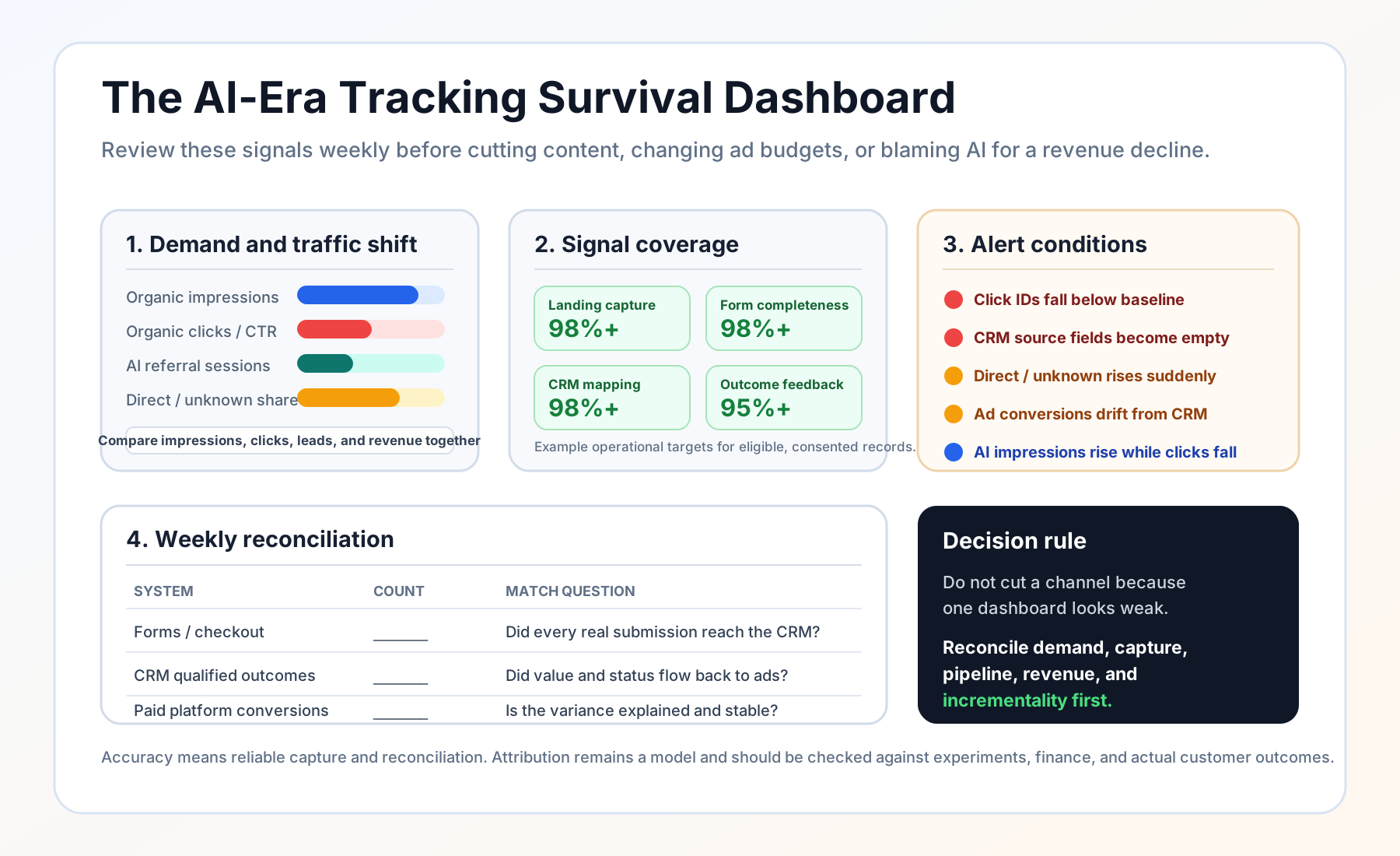
The weekly dashboard that prevents panic decisions
Your team should review four groups of evidence together:
- Demand: impressions, rankings, branded searches, AI visibility, and market interest.
- Traffic: organic clicks, AI referrals, direct/unknown share, landing pages, and conversion rate.
- Signal coverage: source persistence, form completeness, CRM mapping, event delivery, dedupe, and feedback.
- Business outcomes: qualified leads, opportunities, sales, revenue, margin, refunds, and retention.
What survival-grade tracking looks like
- At least 95% of eligible conversion records preserve their observable acquisition signal end to end.
- First-touch and last-touch fields are stored separately and are not overwritten by direct returns.
- Every form, iframe, checkout, booking flow, and domain is tested on real mobile and desktop browsers.
- CRM mapping is reconciled against successful submissions, not assumed from connector status.
- Browser and server events share the same event name and event ID.
- Qualified outcomes and revenue flow back to the platforms that optimize spend.
- Direct and unknown traffic are monitored as a trend, not treated as an explanation.
- AI referrals, self-reported AI discovery, branded demand, and citation visibility are reviewed together.
- Consent, hashing, retention, and data-sharing rules are documented and tested.
- Finance, CRM, analytics, and ad-platform differences have a known explanation.
The goal is not a prettier attribution report. It is a decision system that stays useful when traffic gets smaller, journeys get darker, and algorithms demand cleaner feedback.
What not to do
Do not cut SEO because traffic fell before checking conversion value
An informational page may receive fewer clicks while still influencing branded demand, sales conversations, AI citations, and higher-intent visits. Evaluate pipeline and revenue, not pageviews alone.
Do not claim 100% attribution
No system can directly observe every zero-click answer, cross-device return, private recommendation, or offline influence. Honest unknowns are better than fabricated precision.
Do not send every available field to ad platforms
More parameters can improve matching only when the data is accurate, permitted, formatted correctly, and allowed by platform policy. Sensitive data and prohibited information must not be sent.
Do not let modeled conversions hide a broken implementation
Google explains that modeled key events can estimate conversions that cannot be directly observed because of privacy or technical limitations. Modeling is useful, but it depends on observed data patterns. First fix the conversions you should be able to observe.
Do not optimize toward the easiest event
If your campaign is trained on low-friction form submissions while the business depends on qualified appointments or profitable customers, the platform can become very efficient at generating the wrong outcome.
Where UTM Grabber fits
Protect the remaining signal before it disappears
UTM Grabber preserves first-touch, last-touch, landing-page, referrer, UTM, and click-ID context across the journey so your forms, CRM, orders, bookings, and offline conversion systems receive cleaner attribution data.
- Capture source information immediately on the landing page.
- Preserve attribution across return visits, aggressive caching, and multi-step journeys.
- Populate hidden fields for WordPress forms and supported integrations.
- Keep first-touch and last-touch attribution separate.
- Store Google, Meta, Microsoft, and other click IDs when they are present and permitted.
- Push attribution into CRM, ecommerce, booking, webhook, and automation workflows.
- Build stronger inputs for Meta CAPI, Google enhanced conversions, offline conversions, and internal revenue reporting.
- Audit where a signal was captured, lost, overwritten, or never mapped.
AI is changing how customers discover businesses. Some traffic will be intercepted before the click. Some visits will arrive with weaker source context. Some buyers will know your brand before your analytics ever sees them.
That is not a reason to give up on measurement. It is the reason measurement must become more disciplined.
You may not be able to recover every invisible AI influence. But you can stop losing the evidence that reaches your site. You can connect the remaining clicks to real customers. You can feed ad systems qualified outcomes instead of noise. And you can make the next decision from a trustworthy signal instead of panic.
Sources checked:
- Pew Research Center: Google users are less likely to click when an AI summary appears
- Pew Research Center: A majority of Americans read AI summaries
- Google Search Central: AI features and your website
- Google Search Central: Debug Google Search traffic drops
- Google Search Central: Use Search Console and Google Analytics together
- Google Search Central: Generative AI performance reports in Search Console
- Google Ads: About enhanced conversions
- Google Analytics: About modeled key events
- Google Analytics: Get started with attribution
- Meta Business Help Center: About Conversions API
- WebKit: Tracking Prevention
- Ahrefs: Updated AI Overview click-through-rate study
Preserve first-touch, last-touch, UTMs, click IDs, form attribution, and CRM outcomes before another high-value conversion becomes unknown.