
AI Search Tracking for SEO, AEO, and the LLM Era
For years, search attribution was mostly a Google and Bing story: someone typed a query, clicked a result, landed on your site, and your analytics gave you enough clues to understand the visit.
That model is changing fast. Buyers now ask ChatGPT, Claude, Perplexity, Gemini, Copilot, and Google AI Overviews before they ever touch your website. Sometimes they click a citation. Sometimes they come back later as direct traffic. Sometimes they make a decision without clicking at all.
That makes tracking a core part of modern SEO, AI SEO, AEO, answer engine optimization, GEO, and LLMO strategy. If you cannot see how AI search influences discovery, you cannot protect the traffic and leads those channels are starting to reshape.
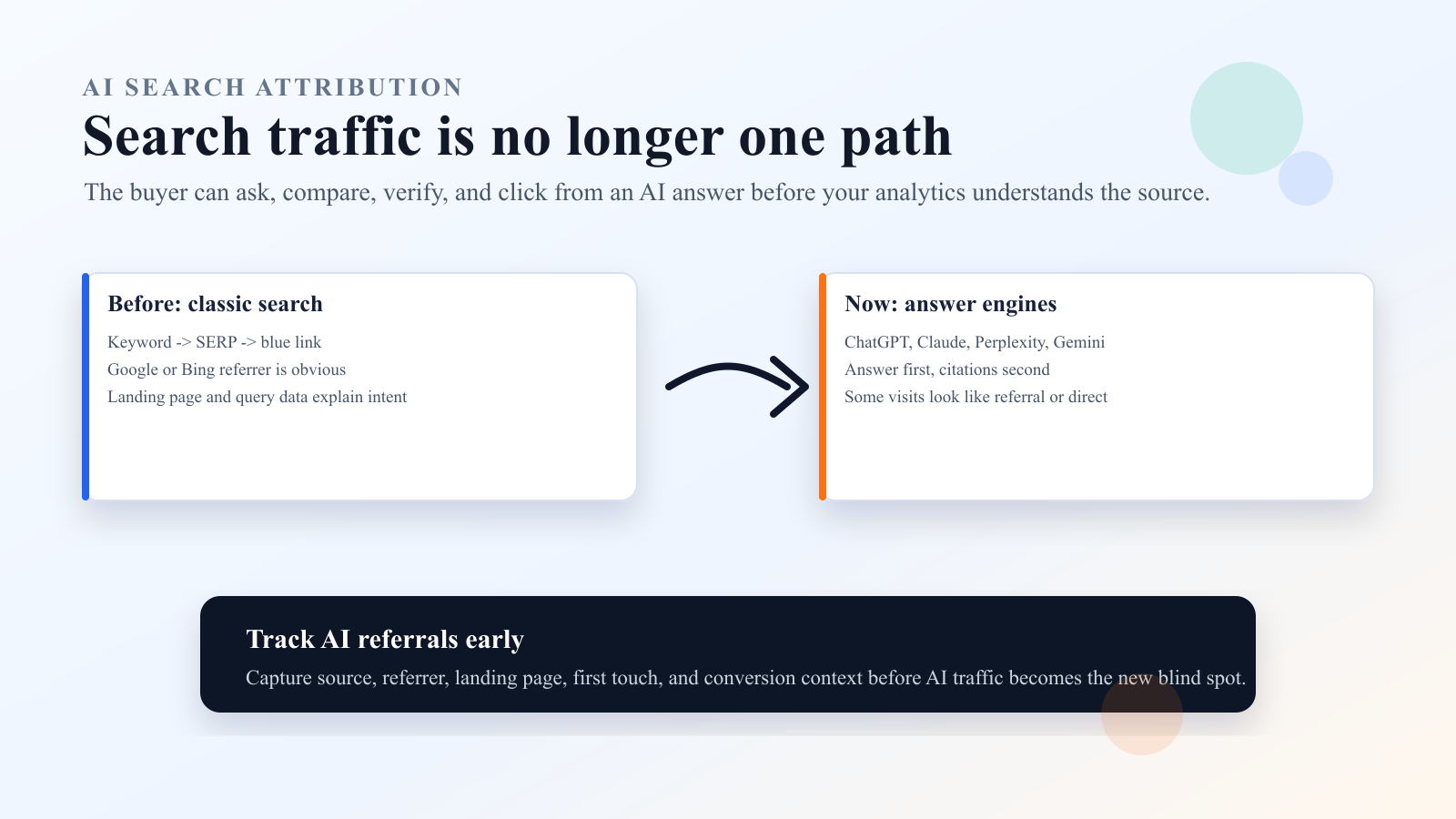
If this feels early, that is exactly the point
- Organic impressions can rise while clicks flatten or fall.
- Visitors may discover you in ChatGPT or Claude, then arrive later as direct traffic.
- Google AI Overviews and AI Mode are blended into normal Search Console reporting.
- AI referral traffic may show up as referral, direct, unassigned, or not at all.
- Your CRM may record the lead, but lose the source that created the trust.
By the time AI traffic is obvious in your reports, your competitors may already know which answers, sources, and pages are winning.
What changed from classic search to AI search
Classic search was a click path
Traditional search was built around a list of results. The user searched, scanned titles, clicked a blue link, and analytics usually captured a recognizable source like Google, Bing, or a paid campaign.
That flow still matters. Google still crawls, indexes, and serves pages through the familiar stages of Search. But the search page is no longer just a list of links.
AI search is an answer layer
OpenAI describes ChatGPT search as timely answers with links to relevant web sources. Anthropic says Claude web search gives current answers with direct citations. Google says AI Overviews and AI Mode can answer more complex questions and surface supporting links through techniques like query fan-out.
The user behavior is different:
- The question is longer and more conversational.
- The AI summarizes before the user clicks.
- The cited source may not be the final landing page.
- The buyer can compare multiple options inside the answer.
- The click, when it happens, is often later and more qualified.
SEO, AEO, GEO, and LLMO are becoming connected
SEO still matters because AI systems often depend on crawled, indexed, trustworthy pages. But the job is expanding. AEO, or answer engine optimization, is about making your content easy for AI systems to understand, summarize, and cite. GEO, or generative engine optimization, focuses on visibility inside generated answers. LLMO, or large language model optimization, is the broader discipline of preparing your brand, content, and data for discovery through LLM-powered tools.
The tracking problem sits underneath all of them. If your AI SEO reports only show rankings and not leads, forms, orders, source history, referrers, and landing pages, you will not know which AI-era visibility is actually creating revenue.
That creates a new attribution problem
If you only look at default channel reports, you will miss the story.
Pew Research Center found that Google users who encountered an AI summary clicked a traditional result less often than users who did not see one. Ahrefs found that many sites already receive some measurable AI chatbot traffic, but also warned that some of this traffic can appear as direct. Cloudflare has also shown a growing gap between AI crawler activity and referral clicks.
That is the real issue. AI discovery is not always the same thing as AI referral traffic.
What to track now
Start with the visible signals:
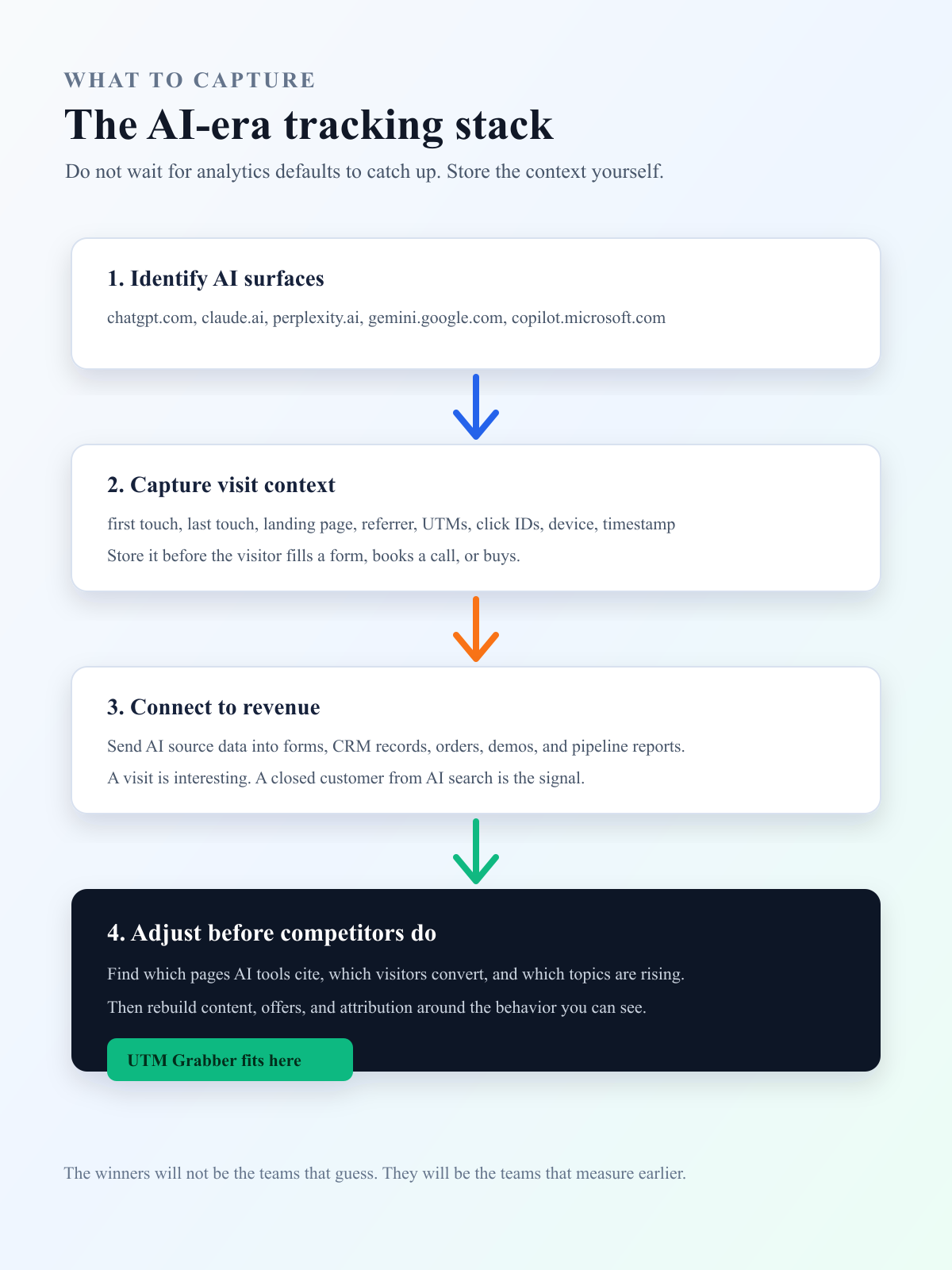
- chatgpt.com
- chat.openai.com
- claude.ai
- perplexity.ai
- gemini.google.com
- copilot.microsoft.com
- bing.com when AI-powered search is part of the journey
Then capture the context that survives the click:
- first landing page
- original referrer
- AI search source and answer engine source
- first-touch source and medium
- last-touch source and medium
- UTM parameters
- click IDs such as gclid, fbclid, and msclkid
- form page, conversion page, and timestamp
- CRM lead source and revenue outcome
- SEO, AEO, and AI SEO content page that influenced the conversion
Sources checked:
- OpenAI: Introducing ChatGPT search
- Claude: Claude can now search the web
- Google Search Central: AI features and your website
- Google Search Central: Succeeding in AI search
- Pew Research Center: Google AI summaries and clicks
- Cloudflare: The crawl-to-click gap
- Ahrefs: AI traffic study
What you lose if you wait
- You may blame SEO when the real issue is answer-engine click suppression.
- You may invest in AEO or AI SEO content without knowing which answers create leads.
- You may miss pages that AI tools are already using as citations.
- You may treat high-intent AI visitors as generic referral or direct traffic.
- You may keep investing in topics that rank but no longer convert.
- You may fail to connect AI-assisted discovery to forms, bookings, pipeline, and orders.
- You may let competitors learn the new demand patterns first.
The danger is not just losing traffic. It is losing the explanation for why traffic changed.
What AI-ready tracking looks like
- AI referral sources are grouped into a dedicated reporting view.
- First-touch and last-touch source data are captured before form submission.
- Landing page and referrer are stored in hidden fields and CRM records.
- Content teams know which pages attract AI-originated visitors.
- Sales teams can see whether AI search leads behave differently from Google leads.
- Marketing can compare AI-assisted pipeline against organic, paid, social, and email.
The goal is not to obsess over every bot. The goal is to preserve enough context to make better decisions.
Why conventional analytics will miss part of this shift
Where UTM Grabber fits
UTM Grabber helps preserve source, referrer, landing page, and campaign context when a visitor converts, so AI-era discovery does not disappear inside direct traffic or generic referral reports.
- Capture first-touch and last-touch attribution data before privacy rules, redirects, or form tools lose context.
- Pass source data into hidden fields, CRM records, WooCommerce orders, bookings, and lead notifications.
- Keep UTMs, click IDs, landing pages, and referrers connected to the conversion record.
- Separate AI search visitors from normal referral traffic when the referrer is available.
- Build cleaner reports for content, SEO, AEO, AI SEO, paid media, and revenue teams.
Who should care now
- SaaS teams that depend on organic demand and comparison content.
- Agencies responsible for explaining traffic drops or lead-source changes.
- WordPress and WooCommerce businesses that need lead and order attribution.
- B2B teams where one AI-assisted visit can become a high-value pipeline opportunity.
- Content teams trying to learn which pages are worth refreshing for AI citations.
- Founders who want to see the market shift before it shows up as lost revenue.
AI search is still early enough to turn tracking into an advantage instead of a postmortem.
What real users are saying
Start preserving source, referrer, landing page, and conversion context before AI search becomes your biggest blind spot.