
UTM Grabber vs Fingerprint.com: Which Tracks the Same Visitor Across Browsers?
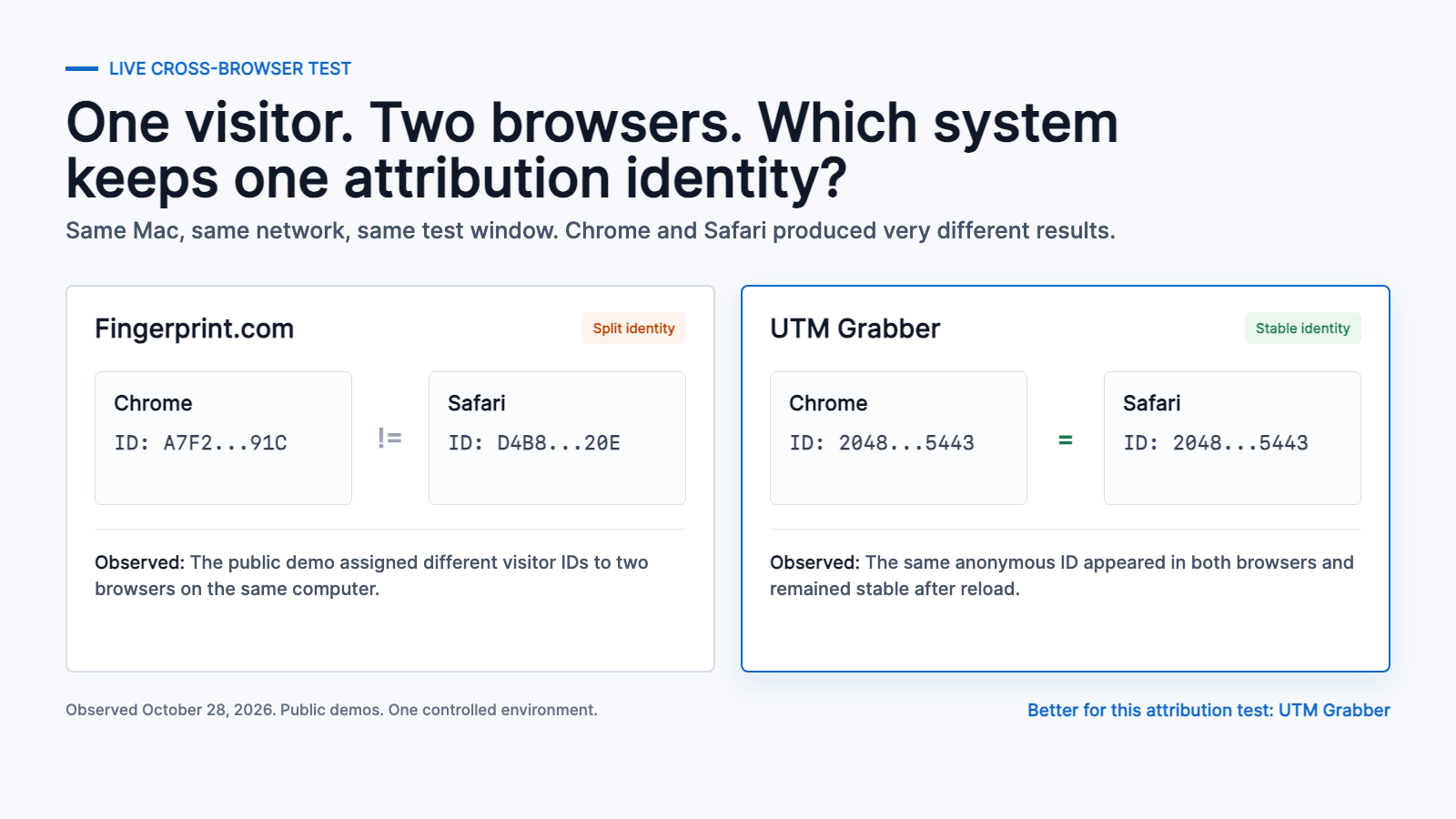
We tested both products on the same Mac, network, and visit window. Fingerprint.com returned one visitor ID in Chrome and a different visitor ID in Safari. UTM Grabber returned the same anonymous visitor ID in both browsers, and that ID remained unchanged after a full page reload.
That does not make Fingerprint.com a bad product. Fingerprint is a mature device-intelligence and fraud-prevention platform. But for the marketing problem that started this test, preserving one attribution identity as a prospect moves between browsers, UTM Grabber performed better in our controlled test.
The X conversation that triggered the test
An X post about browser and device fingerprinting argued that Meta Ads attribution often breaks when people leave Meta's in-app browser, switch browsers, return on another device, or ask someone else to complete a form.
The core idea was correct: a click ID or browser cookie is not always enough to preserve a long, messy buying journey.
In my response on X, I pointed out a specific limitation anyone can test: open Fingerprint.com's demo in Chrome, then open it in Safari. The same computer can receive two different visitor IDs.
So we tested the claim against the live Fingerprint.com and UTM Grabber demos.
What we tested on October 28, 2026
This was a practical browser test, not a laboratory benchmark and not a reverse-engineering exercise.
We used:
- the same Mac
- the same internet connection
- Chrome and Safari
- the public Fingerprint.com live demo
- the public UTM Grabber live tracking demo on the homepage
- a full UTM Grabber page reload to check persistence
We did not inspect or disclose UTM Grabber's identity-generation logic. We recorded only the anonymous IDs displayed by each public demo and compared whether the value stayed consistent.
| Test | Fingerprint.com | UTM Grabber |
|---|---|---|
| Chrome produced an anonymous visitor ID | Yes | Yes |
| Safari produced an anonymous visitor ID | Yes | Yes |
| Chrome and Safari returned the same ID | No | Yes |
| ID stayed the same after a full reload | Not the cross-browser issue tested | Yes |
| Identity is connected to UTM attribution workflows | Requires a separate attribution implementation | Built for it |
Observed result: Fingerprint.com identified the Chrome browser and Safari browser separately. UTM Grabber preserved one anonymous visitor identity across both browsers in this test.
Why did Fingerprint.com return two IDs?
Fingerprint's own documentation gives the most important answer.
Its visitorId API reference defines the value as a browser identifier, or a device identifier on mobile platforms. Fingerprint's AI information page is even more explicit: the platform assigns an ID to a browser or device, not to a person.
Chrome and Safari expose different browser environments. A device-intelligence system can therefore treat them as separate visitors even when they run on the same computer and share the same IP address.
Fingerprint has been working on some cross-browser linking. Its product update says an Enterprise alpha can align native Safari and iOS WebView visitor IDs. Its Related Visitors API can also return visitor IDs associated with the same mobile device, but that capability is not enabled by default and is billed separately.
Those are useful features. They also confirm the underlying point: one Fingerprint visitor ID does not automatically mean one person across every browser.
What does UTM Grabber's stable ID actually mean?
The UTM Grabber result is a stable, pseudonymous attribution identity. It lets a business associate pageviews, campaign data, and conversion activity with the same anonymous visitor record.
That is not the same as knowing someone's legal name. It does not replace login, identity verification, KYC, or consent. A person becomes directly identifiable only when they voluntarily provide information through a form, purchase, account, or another permitted business interaction.
The practical value is continuity:
Ad click -> landing page -> browser change -> return visit -> form submission -> CRM record
If the anonymous identity changes in the middle, the attribution chain can split. The lead may still arrive, but the original campaign, keyword, click ID, and landing page can be missing or assigned to the wrong session.
A stable ID does not identify a person's name. It preserves the marketing journey until the person identifies themselves through a legitimate conversion.
Why cross-browser visitor tracking matters for Meta Ads
Meta Ads journeys rarely stay inside one clean browser session.
A prospect leaves the Meta in-app browser
A person taps an Instagram or Facebook ad, views the landing page inside Meta's browser, then chooses Open in Safari. If the attribution system treats those browsers as unrelated visitors, the campaign context can break before the form is submitted.
A prospect researches in one browser and converts in another
They may first visit in Chrome, return through Safari, and submit a lead form later. A browser-scoped ID can divide one customer journey into two users.
A click ID disappears before conversion
The landing URL may include fbclid, gclid, or UTMs, but redirects, privacy settings, caching, form iframes, and cross-domain steps can remove those values. A stable first-party attribution record gives the system another way to connect the conversion to the earlier visit.
Meta receives a thinner server event
When source data and allowed matching parameters disappear, Meta Conversions API receives less context. That can weaken Event Match Quality, deduplication diagnostics, attribution coverage, and the feedback used for campaign optimization.
Read Facebook _fbc missing when fbclid exists and how to improve Meta Event Match Quality for the event-level side of this problem.
Fingerprint.com vs UTM Grabber: they solve different problems
The products overlap at visitor identification, but their centers of gravity are different.
| Capability | Fingerprint.com | UTM Grabber |
|---|---|---|
| Primary use case | Fraud prevention and device intelligence | Marketing attribution and lead-source persistence |
| Visitor model | Browser or device ID | Stable anonymous attribution identity |
| Cross-browser result in our Mac test | Different Chrome and Safari IDs | Same Chrome and Safari ID |
| UTM source, medium, campaign, term, content | Must be implemented separately | Native attribution data |
| Google, Meta, Microsoft, TikTok click IDs | Must be implemented separately | Captured with the visitor journey |
| First-touch and latest-touch attribution | Not the core product | Native use case |
| WordPress form integration | Custom implementation | 40+ form and platform integrations |
| CRM attribution handoff | Custom implementation | Built for hidden fields, webhooks, Zapier, Make, and CRM flows |
| Fraud signals | Strong: bots, VPNs, tampering, suspect score | Not positioned as a fraud platform |
| Account takeover and payment fraud | Strong | Not the primary use case |
| Data location | Fingerprint service and customer integration | First-party WordPress environment |
Where Fingerprint.com is stronger
Choose Fingerprint when your main problem is:
- account takeover
- payment fraud
- promo or free-trial abuse
- bot and automation detection
- VPN, proxy, emulator, or browser-tampering signals
- risk scoring and step-up authentication
Fingerprint combines its visitor ID with Smart Signals and a suspect score. Those capabilities are valuable and UTM Grabber is not trying to replace them.
Where UTM Grabber is the better choice
Choose UTM Grabber when your main question is:
- Which ad, campaign, keyword, or referral created this lead?
- Can the attribution survive a browser change or delayed conversion?
- Can first touch and latest touch remain separate?
- Can UTM and click-ID values reach my form, CRM, order, or booking record?
- Can my WordPress site keep the data first-party?
- Can I diagnose attribution without building a custom identity pipeline?
For these marketing questions, an ID alone is not enough. The ID must be joined to the campaign and carried into the business record.
Why UTM Grabber is better than Fingerprint.com for this attribution use case
The strongest argument is not simply that the same ID appeared in Chrome and Safari. It is what the product does with that continuity.
1. It starts with attribution, not device risk
UTM Grabber captures campaign parameters, ad click IDs, landing-page context, referrer, and touch history. Visitor identity supports that attribution model instead of existing as a separate fraud signal.
2. It connects anonymous visits to real conversions
When a visitor submits a supported WordPress form, completes a WooCommerce order, or enters a connected workflow, the attribution values can travel with the conversion record.
3. It preserves first touch and latest touch
The first campaign that introduced a prospect and the final campaign before conversion answer different questions. UTM Grabber is designed to keep both instead of overwriting the entire journey with the last pageview.
4. It works inside the WordPress environment
UTM Grabber keeps attribution data in the site's first-party environment. That reduces the number of external systems receiving raw journey data and gives the business more control over retention, access, and deletion.
5. It is already integrated with the marketing stack
The difficult part of attribution is not generating a number. It is ensuring the same source reaches Gravity Forms, WPForms, Elementor, Contact Form 7, HubSpot, Salesforce, GoHighLevel, WooCommerce, Zapier, Make, and the reporting system used by the business.
Read UTM tracking without third-party cookies and the complete tracking failure audit for the broader architecture.
What a reliable attribution identity must preserve
One identity is useful only when it carries the right context
- A stable anonymous visitor ID across the relevant customer journey
- Original UTMs and ad click IDs captured before redirects, caching, or form tools remove them
- First-touch attribution that does not disappear during a direct return visit
- Latest-touch attribution that records the final meaningful acquisition touch
- Landing-page and referrer context for message-match analysis
- Form, booking, and checkout fields that receive the attribution values
- CRM and order mappings that preserve the same structured data
- Browser and server event IDs that support accurate deduplication
- Consent and opt-out behavior appropriate to the visitor's jurisdiction
- Retention and deletion controls for pseudonymous data
The goal is not to follow people everywhere. The goal is to preserve a truthful, consent-aware path from campaign to business outcome.
Privacy: stable does not mean unrestricted
Pseudonymous visitor IDs can still be personal data under privacy laws when they can single out or link activity to a person. A business should treat cross-browser attribution as governed data, not as a loophole around consent or disclosure.
Use these guardrails:
- Explain attribution and first-party identifiers in the privacy policy.
- Honor consent requirements and opt-out signals that apply to the visitor.
- Do not put names, email addresses, medical conditions, financial data, or other sensitive information in UTM parameters or URLs.
- Limit retention to a defensible attribution window.
- Restrict access to raw identifiers and journey records.
- Do not send an internal visitor ID to an advertising platform unless the use is allowed by that platform's terms and your privacy policy.
- Hash customer-information fields when an ad platform requires hashing, and follow its formatting rules.
- Provide deletion and access processes for applicable privacy requests.
Better tracking should produce better evidence, not more uncontrolled data.
Frequently asked questions
Is UTM Grabber a Fingerprint.com alternative?
For WordPress marketing attribution, yes. UTM Grabber provides anonymous visitor continuity plus UTM, click-ID, first-touch, latest-touch, form, and CRM attribution. For fraud detection, account takeover, or bot risk scoring, Fingerprint.com remains the more specialized product.
Does Fingerprint.com identify the same person across Chrome and Safari?
Not automatically in every case. Fingerprint's documentation defines its main ID as a browser or device identifier. In our public-demo test, Chrome and Safari on the same Mac received different Fingerprint visitor IDs.
Did UTM Grabber return the same ID in Chrome and Safari?
Yes. In our October 28, 2026 test, the UTM Grabber live demo displayed the same anonymous visitor ID in Chrome and Safari on the same Mac and network. The value also remained unchanged after a full reload in Chrome.
Does that prove UTM Grabber recognizes every person on every device?
No. It proves the observed public-demo result under the stated conditions. No anonymous identifier should be described as universal identity verification.
Is browser fingerprinting cookieless tracking?
Browser fingerprinting can recognize a browser without relying only on a traditional cookie, but practical attribution systems often combine multiple first-party signals, stored journey data, and deterministic conversion information. Cookieless does not mean lawless or perfect.
Can a stable visitor ID improve Meta CAPI attribution?
It can help preserve the journey that feeds a server conversion, but it is not a substitute for Meta's required and permitted parameters. Use matching event_id values for browser and server deduplication, preserve fbclid and _fbc when available, and send allowed customer information in the required format.
Is the visitor ID personally identifiable information?
It is pseudonymous, not a legal name or direct identity. Depending on the jurisdiction and how it is used, it can still qualify as personal data or an online identifier and should be governed accordingly.
The conclusion from the live test
Fingerprint.com is excellent at telling a fraud or security team what kind of browser or device is making a request and whether that request looks risky.
UTM Grabber is built to answer a different question: Which marketing journey produced this lead, booking, customer, or order?
In our Chrome and Safari test, Fingerprint.com's public demo split one Mac into two visitor IDs. UTM Grabber's public demo preserved one anonymous visitor ID across both browsers and across a reload.
That is why UTM Grabber is the better Fingerprint.com alternative for WordPress lead attribution. It does not stop at identifying a browser. It preserves the campaign story that the business can carry into forms, CRM records, conversions, and revenue.
Keep one attribution identity across the journey
Test the live demo yourself, then install UTM Grabber on your WordPress site.
Sources checked
- Original X post on browser fingerprinting and Meta attribution
- Haktan Suren's cross-browser response
- Fingerprint.com live device-intelligence demo
- Fingerprint: JavaScript agent get function and visitorId definition
- Fingerprint: what its visitor ID does and does not identify
- Fingerprint: Safari and iOS WebView visitor-ID product update
- Fingerprint: Related Visitors API
- UTM Grabber: live tracking demo