
Facebook _fbc Missing When fbclid Exists? How to Debug Meta CAPI Click ID Loss
If you see fbclid on the landing page but _fbc is missing later in Pixel, form, CRM, or Meta Conversions API data, do not assume your checkout is broken.
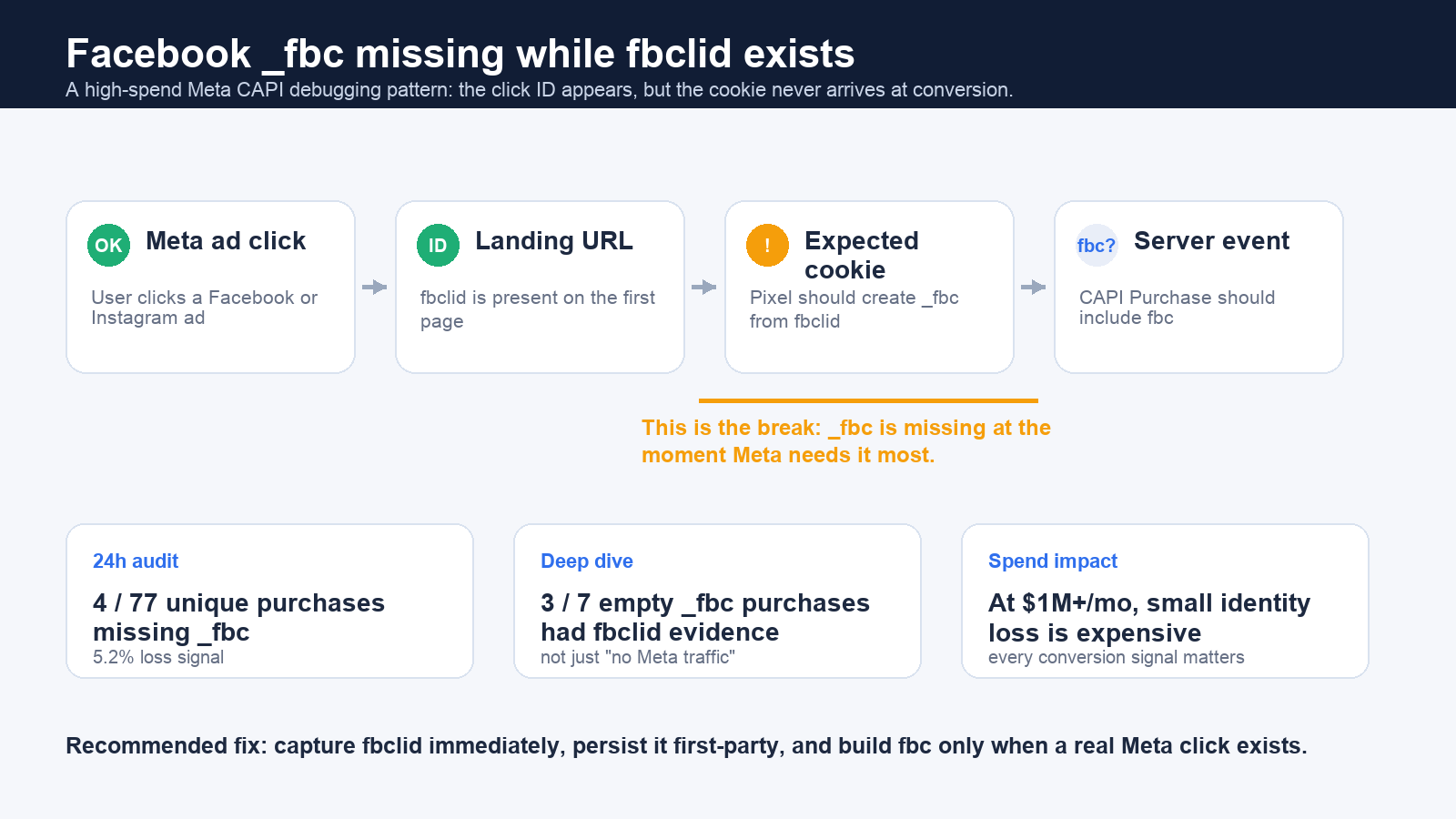
Sometimes the failure happens earlier: the Meta click ID arrives, but the expected first-party _fbc value is never created, never persisted, or never reaches the server conversion.
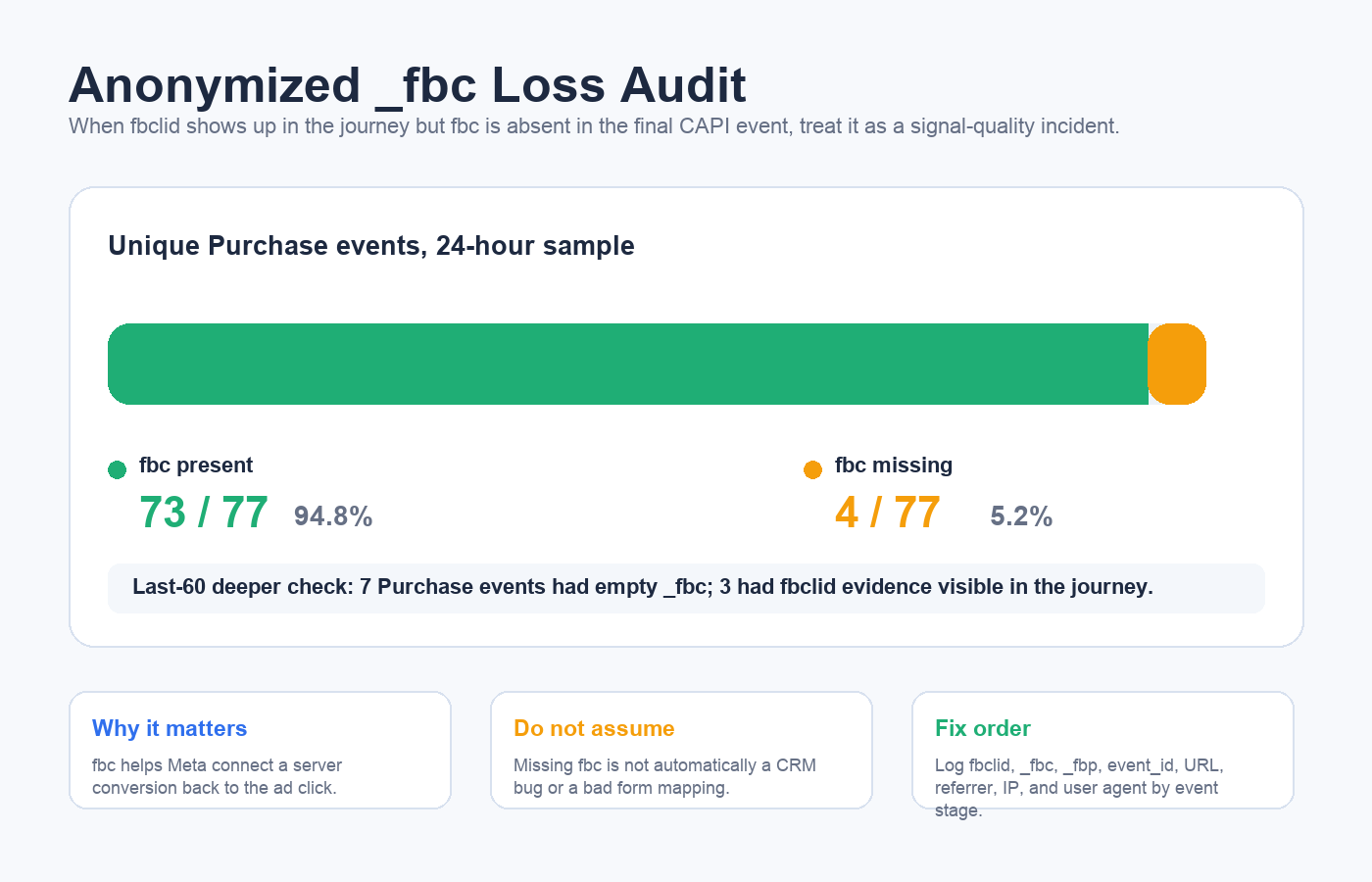
In an anonymized high-volume audit, one 24-hour pull showed 4 of 77 unique Purchase events missing fbc, or 5.2%. A deeper last-60-event check found 7 Purchase events with empty _fbc, and 3 of those had clear fbclid evidence somewhere in the journey.
That is the uncomfortable part: this is not always a simple tracking-template mistake. If you are spending more than $1M/month on Meta Ads, a 4-6% click-ID gap can distort attribution, Event Match Quality, and optimization feedback.
If this sounds familiar
- Meta Events Manager shows weaker Event Match Quality or click matching than expected.
- Your server Purchase or Lead event has
fbp, email, IP, or user agent, but nofbc. - The landing URL contains
fbclid, but the final conversion payload has emptyfbc. - You first suspect hidden fields, CRM mapping, or checkout, but journey logs show the gap started earlier.
- The issue appears random, affecting a small percentage of paid Meta journeys.
- Some events have Meta UTMs or ad parameters, but no click ID makes it into the final CAPI payload.
The fix is not to guess. The fix is to prove exactly where fbclid becomes, or fails to become, fbc.
The short answer
When fbclid is present but _fbc is missing, you have a click-ID persistence problem. Meta's Pixel usually creates _fbc from fbclid, but real funnels add consent tools, redirects, caching, in-app browsers, cross-domain checkouts, tag timing, server-side GTM, and form/CRM handoffs. Any of those can break the chain.
The right fix is to capture fbclid immediately, store it as first-party attribution context, and send a valid fbc value to Meta CAPI only when you have proof of a real Meta click.
Do not confuse this with event deduplication. event_id deduplicates browser and server events. fbc helps Meta connect the conversion to the click. You usually need both.
What _fbc is supposed to do
The normal Meta click ID path
Meta's documentation describes ClickID as a "Meta-generated" URL parameter passed when a user clicks an ad on Facebook or Instagram. That URL parameter is fbclid.
In a clean setup, the path looks like this:
- A user clicks a Facebook or Instagram ad.
- Meta appends
fbclidto the landing URL. - Meta Pixel sees the value and stores it in the browser as
_fbc. - Your browser event and server event include
fbcwhen available. - Meta uses that click ID, along with other match data, to improve attribution and delivery feedback.
Meta's docs also say that if the _fbc cookie is not available but fbclid is present, you can format the ClickID for CAPI as:
fb.<subdomainIndex>.<creationTimeMs>.<fbclid>
For most root-domain storage patterns, that looks like:
fb.1.1770000000000.IwY2xjaw...
The timestamp should be when you first observed or received the fbclid value. Also, do not lowercase, uppercase, trim into a different value, or otherwise modify fbclid. Meta calls out that the ClickID is case sensitive.
Why missing _fbc matters
Some teams treat fbc as a nice-to-have parameter. That is risky.
fbc is one of the clearest paid Meta click signals you can send with a server-side conversion. If it drops, Meta may still match with email, phone, IP, user agent, fbp, or external ID, but the event has lost direct click continuity.
That matters most when:
- spend is high enough that a few percentage points changes budget decisions
- conversions are expensive or low-volume
- purchase happens after a multi-step funnel
- the user moves across domains before buying
- the final conversion is server-side, offline, or CRM-generated
- the account relies on CAPI to recover browser-side signal loss
What we saw in the anonymized audit
The important pattern was not merely "some purchases had empty fbc." That can happen for normal reasons. Not every buyer comes from Meta.
The important pattern was this:
| Audit signal | Result | What it means |
|---|---|---|
| Unique Purchase events in one 24-hour pull | 77 | High enough to spot a repeatable signal issue. |
Unique purchases missing fbc | 4 | 5.2% missing in that sample. |
Last-60 Purchase events with empty _fbc | 7 | Enough to inspect individual journeys. |
Empty-_fbc purchases with strong fbclid evidence | 3 | Click ID existed somewhere, but fbc did not survive to conversion. |
Empty-_fbc purchases with Meta UTMs/ad params but no strict click proof | 3 | Likely Meta context, but not enough proof to claim click-ID failure. |
Empty-_fbc purchase with no source proof | 1 | Should not be counted as a Meta click issue. |
That distinction matters. Do not inflate the problem by counting every missing fbc as Facebook traffic. But also do not dismiss the problem when journey logs prove fbclid existed.
Why this gets missed
- They check the Purchase event and see empty
fbc, but do not inspect PageView, InitiateCheckout, form submit, and redirect logs. - They assume
fbclidmeans_fbcmust exist, which is not always true in real browsers. - They rely on Meta Pixel to create the cookie, but consent, cache, tag timing, or browser behavior delays the write.
- They pass UTM parameters across domains, but forget
fbclid,_fbc, and_fbp. - They send CAPI events from the backend after checkout, but the backend never received the click identifiers.
Most teams audit the final conversion payload, not the whole click journey.
Is Facebook failing to create _fbc?
Maybe. But phrase it like an engineer, not like a conspiracy.
If all of these are true, then the Meta/browser click-ID handoff becomes a serious suspect:
- The original URL or journey log shows
fbclid. - Meta Pixel is installed and allowed to run.
- The user stayed in a browser context where a first-party cookie should be possible.
- No redirect, cache layer, consent rule, or domain switch stripped the parameter before Pixel could read it.
_fbcis still missing in PageView, InitiateCheckout, Purchase, and server logs.
At that point, I would not keep blaming the CRM. I would classify it as a click-ID creation or persistence gap and build a fallback capture layer.
Public threads show similar symptoms. In a Stape community discussion, the issue was timing: "cookie is not yet available" when the tag fires. In a Reddit Meta Ads thread, an advertiser reported that some fbc values were "undefined" at the end. A WordPress support thread traced an fbc issue to caching where the plugin never saw the new fbclid value.
The lesson is simple: fbclid to _fbc is a chain, not a guarantee.
What to fix first
- Capture
fbclidimmediately on the first landing page request or first client-side page load. - Store first-touch and latest-touch click context in a first-party place you control.
- Preserve
fbclid,_fbc, and_fbpacross redirects, checkout domains, forms, and CRM handoffs. - Send
fbconly when valid: from the_fbccookie or from a realfbclidyou observed. - Send
fbp, IP address, user agent, and hashed customer information when allowed. - Use the same
event_idon browser and server events when they describe the same conversion. - Alert when
fbclid_present = trueandfbc_sent_to_capi = falsecrosses your threshold.
Do this before you rebuild campaigns or decide Meta traffic quality changed overnight.
The debugging checklist
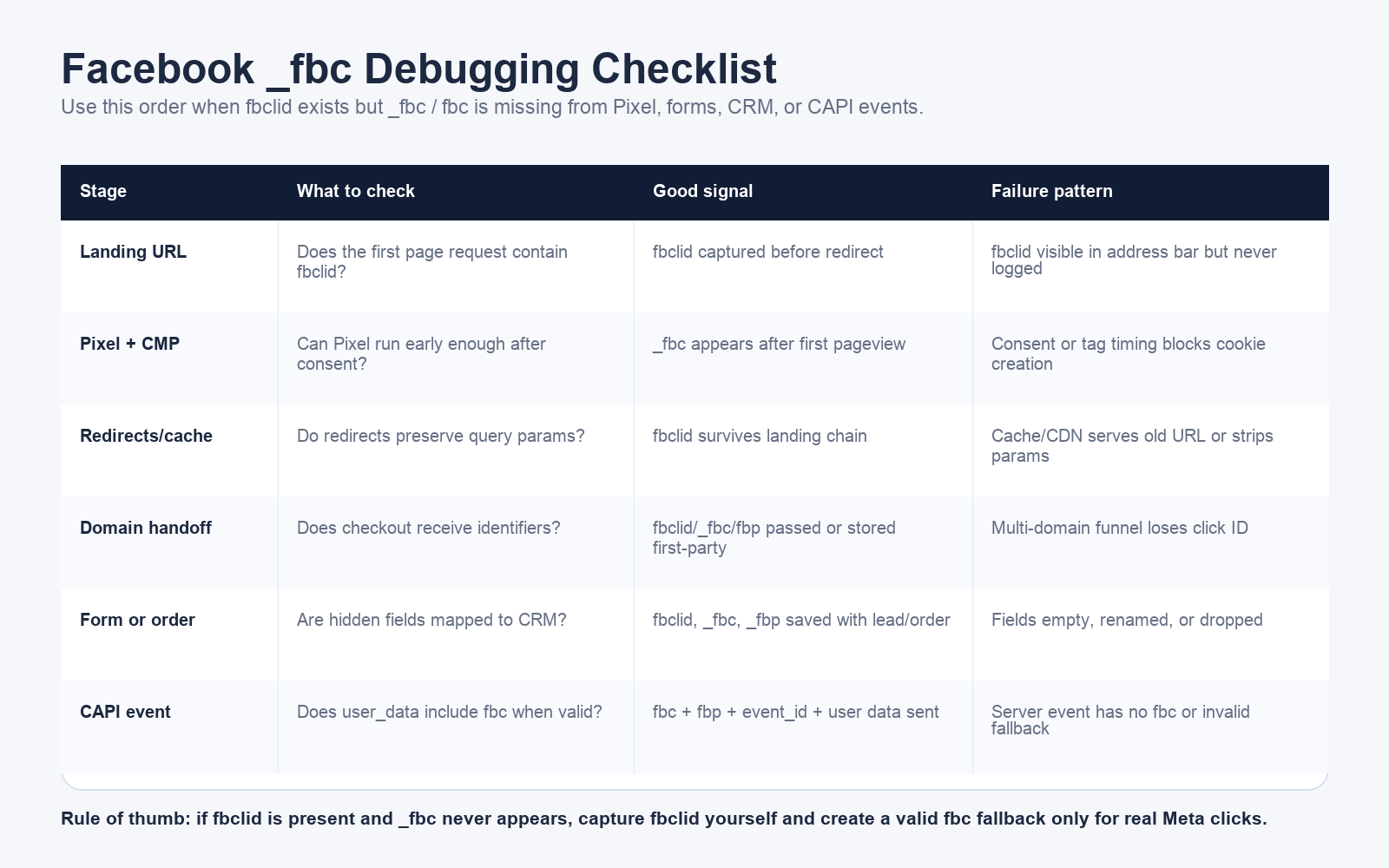
Use this order. It keeps the investigation from turning into finger-pointing between paid media, dev, analytics, and CRM teams.
1. Confirm the click really came from Meta
Look for strict proof first:
fbclidin the URL- Facebook or Instagram referrer where available
- Meta ad click redirect path
- Meta UTMs plus ad IDs, when your tracking template is reliable
Do not count every utm_source=fb visit as proof. UTMs can be copied, cached, reused, or manually added. fbclid is the stronger signal.
2. Log before and after every handoff
For high-spend accounts, you should be able to answer this for any conversion:
| Stage | Values to log |
|---|---|
| Landing page | full URL, fbclid, referrer, consent state, timestamp |
| First page event | _fbc, _fbp, event ID, user agent |
| Form or checkout start | fbclid, _fbc, _fbp, handoff URL, session ID |
| Lead/order record | stored click IDs, UTMs, landing page, first-touch source |
| CAPI event | fbc, fbp, event ID, IP, user agent, hashed identifiers |
| Meta response | diagnostics, match quality, warning codes, test event result |
The log should be privacy-aware. Do not store raw personal data longer than you need. Hash contact fields before sending them to Meta where required. Keep raw click IDs governed by your consent and retention policy.
3. Build fbc yourself when Pixel does not
If fbclid is present and _fbc is missing, you can create a valid fbc fallback for the server event.
Conceptually:
function buildFbcFromFbclid(fbclid, firstSeenMs, subdomainIndex = 1) {
  return `fb.${subdomainIndex}.${firstSeenMs}.${fbclid}`;
}
Rules:
- Only build
fbcwhenfbclidis real and observed. - Use the timestamp when you first saw that
fbclid. - Keep the original
fbclidcase and characters intact. - Do not send
fbcasnull,undefined, empty string, or a made-up click. - Prefer the actual
_fbccookie when it exists and is current.
fbclid and no valid _fbc, omit fbc. A bad identifier can be worse than a missing one.4. Check consent and tag timing
Many _fbc issues look random because consent and timing are random.
A user may accept cookies after the first page event. A tag may fire before Meta Pixel creates _fbc. A server-side GTM setup may read event data before the browser cookie exists. A checkout may redirect before the Pixel has time to write.
That is why your tracking should not depend on one late browser read. Capture fbclid as soon as possible and keep it available for the later conversion.
5. Check caching and redirects
Caching can make this ugly.
One public WordPress support thread found that a cached page prevented the plugin from seeing a fresh fbclid, which caused stale or incorrect fbc behavior. That exact failure mode can happen in different shapes with WP Rocket, CDN cache rules, landing page builders, checkout links, URL cleaners, and redirect scripts.
Audit:
- Does the first URL preserve
fbclidafter redirects? - Does your cache vary or bypass on click-ID query parameters?
- Does a URL cleaner remove
fbclidbefore Pixel runs? - Does your checkout link rebuild the URL without click IDs?
- Does the final domain have access to first-touch identifiers?
6. Do not use fbc as your only match signal
A clean Meta CAPI event should not rely on one identifier.
When you have permission and a lawful basis, send:
fbcfbpclient_ip_addressclient_user_agent- hashed email
em - hashed phone
ph - hashed first name, last name, city, state, ZIP, country where available
- stable
external_id - matching
event_idbetween browser and server
Meta's customer information parameter docs say unhashed contact information is generally not accepted unless specifically noted, so normalize and hash required fields correctly.
Why this matters for paid media decisions
How UTM Grabber helps
UTM Grabber is built for exactly this kind of messy attribution path: the click happens early, the conversion happens later, and the final system only knows what survived.
- Capture UTMs,
fbclid,gclid,msclkid, and click context before funnels strip them. - Persist identifiers through forms, orders, CRM fields, and server-side conversion workflows.
- Keep first-touch and latest-touch data available for Meta CAPI, Google offline conversions, and revenue reporting.
- Reduce the risk that a random browser or cache behavior becomes a permanent attribution blind spot.
A practical alert to add this week
Create a simple monitor for paid Meta traffic:
if fbclid_present == true
and fbc_sent_to_capi == false
then flag "Meta click ID loss"
Track it by landing page, browser, device, campaign, domain handoff, and consent status.
Suggested thresholds:
| Spend level | Alert threshold |
|---|---|
| Under $50k/month | investigate above 5-10% |
| $50k-$250k/month | investigate above 3-5% |
| $250k-$1M/month | investigate above 2-3% |
| $1M+/month | investigate above 1-2% |
The higher the spend, the less patience you should have for unidentified signal loss.
FAQ
Is _fbc always created when fbclid exists?
It should be created in a clean Meta Pixel flow, but real-world implementations can prevent it: consent timing, redirects, cache, browser restrictions, server-side tag timing, cross-domain checkout, or scripts that strip query parameters.
Should I send fbc if it is empty?
No. Send a valid fbc value or omit it. Do not send empty, undefined, stale, or fabricated values.
Can I build fbc from fbclid?
Yes, when fbclid is present and you observed it on the user journey. Use Meta's documented format and timestamp from when you first observed the click ID.
Does fbc replace event_id?
No. Use event_id for browser/server deduplication. Use fbc as a click identifier that helps Meta connect the conversion to the ad click.
What should I fix first?
Capture fbclid immediately, preserve it through the funnel, create fbc only when valid, and confirm the same event ID is used for browser and server events.
Sources checked:
- Meta for Developers: ClickID and the fbp and fbc parameters
- Meta for Developers: Customer information parameters
- Meta Business Help: Cookie settings for Meta Pixel
- Stape Community: client-side _fbc cookie overwritten by CAPI tag
- Stape Community: _fbc and fbclid behavior in server-side tagging
- WordPress.org support thread: expired fbclid value in fbc parameter
- Reddit r/FacebookAds: fbc cookies listed as undefined
- Reddit r/GoogleTagManager: adding fbc parameter to Meta CAPI
Who should audit this now
- Meta advertisers spending six or seven figures per month.
- Ecommerce teams sending Purchase events through CAPI.
- Lead-gen teams using multi-step funnels, booking pages, or CRM events.
- Agencies responsible for Event Match Quality, CAPI coverage, and attribution QA.
- WordPress, WooCommerce, Shopify, and custom funnel teams dealing with cache, consent, and cross-domain tracking.
If your account is big enough that small signal loss changes decisions, this is worth fixing before the next budget review.
What real users are saying
Find where fbclid, _fbc, _fbp, and event_id disappear before Meta learns from incomplete data.