
How to Track AI Referral Traffic from ChatGPT, Gemini, and Claude
People do not discover businesses only through Google and Bing anymore. They ask ChatGPT, Gemini, Claude, Perplexity, and Copilot, read a synthesized answer, and sometimes click a cited source.
To track AI referral traffic correctly, capture the referring AI domain when the visitor arrives, preserve it through the full customer journey, pass it into the form and CRM, and connect it to qualified leads and revenue. HandL UTM Grabber does this with organic_source, organic_source_str, first-touch referrer, landing-page, and last-touch fields.
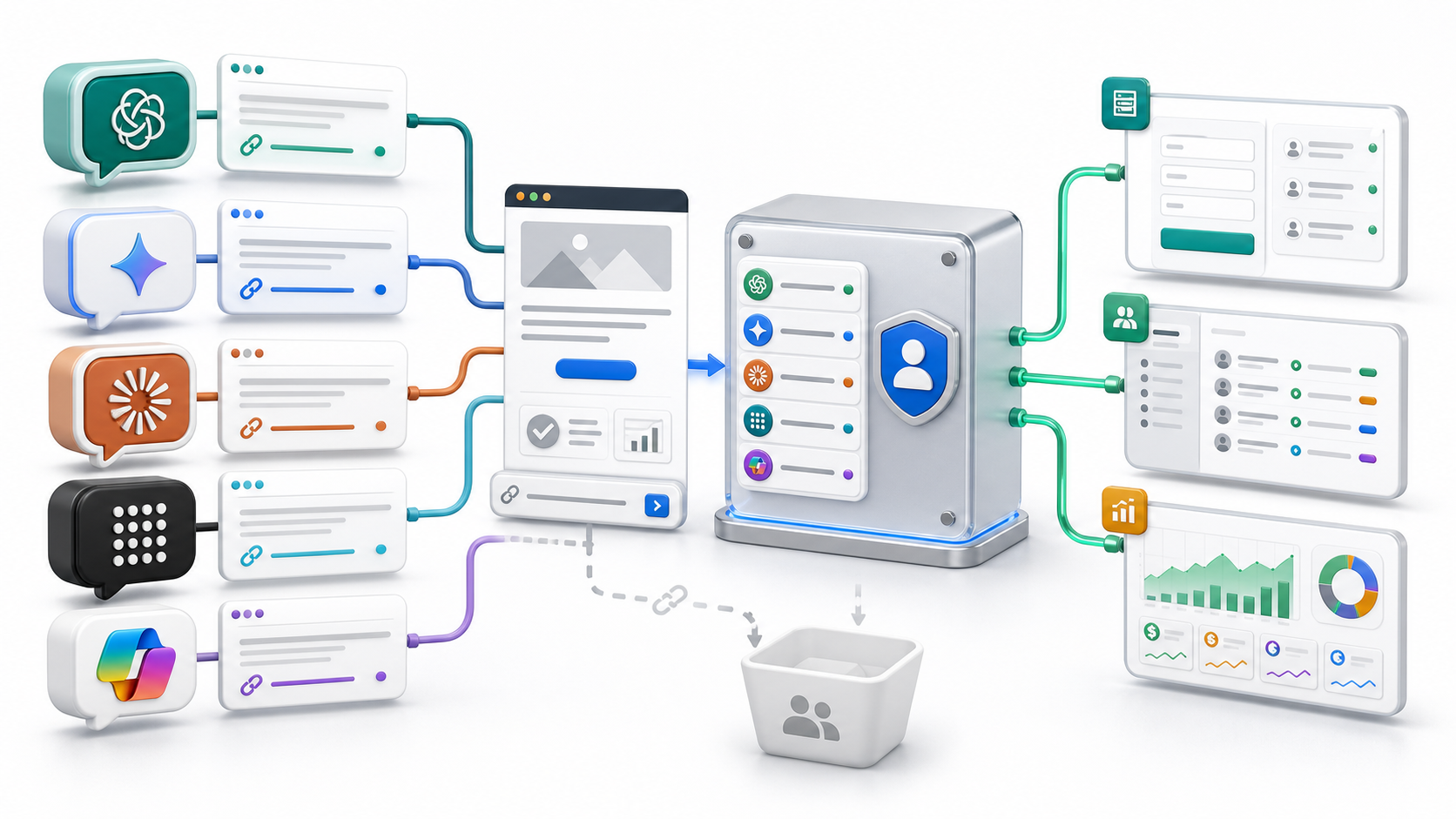
organic_source_str. It converts a recognizable AI referrer into a clean source label such as OpenAI, Gemini, Claude, Perplexity, or Copilot so the source can travel with the lead.Why AI search traffic disappears from attribution reports
- ChatGPT sends a valuable visitor, but the form submission reaches the CRM with no source.
- Gemini or Claude appears under generic Referral traffic, so nobody reports it separately.
- A visitor discovers the brand in an AI answer, returns through Google, and AI receives no credit.
- Mobile or desktop assistant apps suppress the referrer, causing an AI visit to appear as Direct.
- GA4 shows sessions, but sales cannot connect the source to a qualified lead or closed deal.
- Marketing reports AI citations and website traffic but cannot prove which pages create pipeline.
- AI crawler requests are mixed with real human visits, inflating engagement and conversion events.
AI discovery is already fragmented. Your measurement should not fragment it further.
Can you track traffic from AI assistants?
Yes, when the assistant sends a usable HTTP referrer or a tagged link. A click from chatgpt.com, gemini.google.com, claude.ai, perplexity.ai, or copilot.microsoft.com can identify the referring platform even though it usually does not reveal the user's original prompt.
You cannot identify every AI-assisted visit. Referral information may be removed by:
- a mobile or desktop app
- a privacy setting or browser policy
- an intermediate redirect
- a copied and pasted URL
- a link that uses
noreferrer - an assistant interface that does not pass a referrer
When that happens, the visit can look like Direct / None. Google Analytics documents that Direct traffic means the source is not clearly available, not necessarily that the person typed the domain manually.
AI attribution therefore has a visible layer and an invisible layer. Track the visible referrals precisely, preserve them through conversion, and report the invisible portion as an acknowledged limitation instead of guessing.
Traditional search is not dead, but the journey has changed
It would be inaccurate to say nobody uses Google or Bing. Traditional search still drives enormous traffic. What changed is that a growing part of discovery now begins inside an answer engine.
The conventional journey looked like this:
Search query -> Search results page -> Website click -> Analytics session -> Conversion
The AI-assisted journey can look like this:
Natural-language prompt -> Synthesized answer -> Brand mention or citation -> Website click -> Later return visit -> Conversion
OpenAI confirms that ChatGPT Search can search the web, produce responses with citations, and let users open cited sources. Similar citation and web-search patterns exist across Gemini, Claude, Perplexity, and Copilot.
The market is also moving quickly. StatCounter reported that in March 2026 ChatGPT remained the largest source of AI chatbot referrals, while Gemini moved ahead of Perplexity and Claude's share increased. BrightEdge separately reported strong Q1 2026 growth for Gemini and Claude.
The exact platform percentages vary by dataset and industry. The stable lesson is that AI referral traffic is no longer one source named ChatGPT. It is a source category made of multiple fast-changing assistants.
For the broader strategy behind SEO, AEO, GEO, and LLMO, read AI Search Tracking for SEO, AEO, and the LLM Era.
What organic_source_str records
HandL UTM Grabber provides two complementary organic attribution values:
| Parameter | Example | Purpose |
|---|---|---|
organic_source | https://chatgpt.com/... | Preserves the referring source URL when it is available. |
organic_source_str | OpenAI | Converts the referrer into a clean, reportable source label. |
The UTM Grabber organic tracking documentation defines organic_source as the organic source URL and organic_source_str as the readable source name.
As of UTM Grabber 3.1.7, the built-in organic source logic recognizes these AI assistant patterns:
| AI source label | Referrer-domain pattern recognized by UTM Grabber | Typical visitor source |
|---|---|---|
| OpenAI | Referrer contains openai or chatgpt | ChatGPT Search, citations, and related OpenAI web surfaces |
| Perplexity | Referrer contains perplexity | Perplexity answers and citations |
| Claude | Referrer contains claude | Claude web search and cited links |
| Gemini | Referrer contains gemini | Google Gemini assistant links |
| Copilot | Referrer contains copilot | Microsoft Copilot citations and links |
UTM Grabber also recognizes Google, Bing, Yahoo, Facebook, Instagram, LinkedIn, YouTube, Pinterest, and other traditional organic or referral sources. This matters because one data model can compare AI discovery, search discovery, social discovery, and paid campaigns without creating a separate attribution system for each trend.
organic_source_str is not the same as utm_source
These fields answer related but different questions.
utm_sourceis a campaign parameter included in a URL. It is strongest when you control the link.organic_source_stris inferred from the actual referrer. It is useful when a third-party AI assistant creates or presents the link and no UTM parameters exist.
For example, a normal ChatGPT citation may link directly to:
https://example.com/helpful-guide/
There may be no UTM parameters, but the browser can still send chatgpt.com as the referrer. UTM Grabber can classify that visit as OpenAI through organic_source_str.
If your company controls a link placed inside a custom GPT, AI agent, partner assistant, shared prompt, or conversational campaign, add explicit UTMs:
?utm_source=chatgpt&utm_medium=ai_assistant&utm_campaign=custom_gpt_leads
In that controlled case, keep both values. The UTM identifies the campaign you created, while the organic referrer helps confirm the platform that delivered the click.
How to implement AI referral tracking with UTM Grabber
The implementation is small, but it must reach beyond the browser.
Step 1: Capture the AI referrer on the landing page
When a person clicks a citation or source link from a supported AI assistant, UTM Grabber reads the referrer and makes the organic fields available:
[organic_source][organic_source_str][handl_original_ref][handl_landing_page][handl_ref][handl_url]
The original fields matter because the visitor may navigate through several pages before converting. By the time the form is submitted, the current referrer may be an internal page rather than ChatGPT or Gemini.
Step 2: Add attribution fields to the form
Create hidden fields for the attribution values your team needs. A practical minimum is:
| CRM or form field | UTM Grabber value | What it tells you |
|---|---|---|
ai_organic_source | [organic_source] | The available referring AI URL or domain. |
ai_source_name | [organic_source_str] | Clean source label such as OpenAI or Claude. |
first_referrer | [handl_original_ref] | The original first-touch referrer. |
first_landing_page | [handl_landing_page] | The page cited or opened first. |
last_referrer | [handl_ref] | The most recent referrer before conversion. |
conversion_page | [handl_url] | The page where the final tracked action occurred. |
The exact hidden-field syntax varies by form builder. Follow the relevant UTM Grabber integration guide for Elementor, Contact Form 7, WPForms, Ninja Forms, Gravity Forms, HubSpot, GoHighLevel, Salesforce, or your specific form and CRM stack.
Seeing OpenAI in a cookie or browser console is not enough. The value must be present in the submitted payload.
Step 3: Map every field into the CRM
Create dedicated CRM properties instead of hiding AI attribution inside a long note field. Recommended properties include:
- First Touch Source
- First Touch Referrer
- First Landing Page
- Latest Touch Source
- Latest Referrer
- Conversion Page
- Lead Status
- Opportunity Value
- Closed Revenue
Then verify the mapping through every connector:
WordPress form -> Form submission -> Webhook or automation -> CRM contact -> Deal or opportunity -> Revenue report
If Zapier, Make, native CRM integration, or a webhook omits organic_source_str, the source disappears even though UTM Grabber captured it correctly.
Step 4: Preserve first touch and last touch separately
AI discovery often happens before the conversion session.
Consider this journey:
- A prospect asks Claude for the best attribution tools for WordPress.
- Claude cites your educational article.
- The prospect reads the article but does not convert.
- Three days later, the prospect searches the brand on Google.
- The prospect submits a demo form and becomes a customer.
The useful attribution record is:
- First touch: Claude
- First landing page: the cited educational article
- Last touch: Google
- Conversion page: the demo page
- Revenue source analysis: AI-assisted discovery followed by branded search
If you store only the last touch, Google gets all the credit. If you store only the first touch, you miss the channel that brought the user back. Preserve both and decide which model answers the business question.
Step 5: Connect the source to lead quality and revenue
Sessions alone do not tell you whether AI traffic matters. Join organic_source_str with downstream outcomes:
- form submission
- booked demo
- qualified lead
- sales accepted lead
- opportunity created
- pipeline value
- closed-won revenue
- purchase value
- subscription or customer lifetime value
This lets you answer questions such as:
- Does ChatGPT send more qualified leads than Google organic?
- Which Gemini-cited landing pages create pipeline?
- Does Claude influence high-value B2B opportunities?
- Does Perplexity send research traffic or buyers?
- How many Copilot leads return through branded search before converting?
The result is AI conversion attribution, not merely AI traffic reporting.
What AI referral data can and cannot tell you
| Question | Can referral tracking answer it? | Explanation |
|---|---|---|
| Which AI platform sent the visible click? | Usually | The referrer can identify ChatGPT, Gemini, Claude, Perplexity, or Copilot. |
| Which landing page did the assistant cite? | Yes | Store the first landing page and requested URL. |
| Did the visitor become a lead or customer? | Yes | Pass the attribution into the form, CRM, and revenue record. |
| What exact prompt did the user type? | Usually no | The assistant generally does not pass the private prompt to the destination site. |
| Was the brand mentioned without a click? | No | Website analytics cannot observe an AI answer that never sends a visitor. Use separate AI visibility monitoring. |
| Can every AI visit be detected? | No | Missing referrers can make some visits look Direct. |
| Was the request an AI crawler or a human visitor? | Not from source name alone | Use bot detection, user-agent, behavior, and server logs to separate crawlers from human sessions. |
This distinction prevents a common reporting mistake: AI citations, AI referral clicks, AI-assisted conversions, and AI crawler activity are four different metrics.
AI referral traffic versus AI crawler traffic
An AI assistant can interact with your website in two very different ways:
- Crawler or retrieval request: A bot fetches content to index, retrieve, summarize, or evaluate it.
- Human referral visit: A person clicks a source link in an AI answer and opens your website.
Only the second is customer traffic. A crawler should not trigger lead, add-to-cart, purchase, Meta Pixel, Google Ads, or CRM conversion events.
Use server logs, user-agent inspection, behavioral checks, bot protection, and conversion validation to keep crawler requests out of business reporting. Read AI Bot Traffic Is Breaking Conversion Tracking for the filtering and ad-optimization side of this problem.
How to report AI traffic in GA4 without losing CRM attribution
GA4 can report visible AI domains through referrer and session source dimensions. You can create an exploration, comparison, or custom channel rule matching domains such as:
chatgpt.comopenai.comperplexity.aiclaude.aigemini.google.comcopilot.microsoft.com
But GA4 should not be the only copy of the source. Analytics configuration changes, consent behavior, session rules, referrer exclusions, redirects, and missing referrers can alter channel reporting.
Use a two-layer model:
| Layer | Best use |
|---|---|
| GA4 session and page data | Traffic trends, engagement, landing pages, content performance, and channel comparisons |
| UTM Grabber plus CRM fields | Persistent first-touch and last-touch source, lead quality, opportunity value, and closed revenue |
Optionally pass the clean source label into GA4 as a custom dimension when your consent and analytics configuration permit it. Keep the CRM record as the durable conversion-side evidence.
How to test ChatGPT, Gemini, Claude, Perplexity, and Copilot tracking
Do not test AI referral tracking by typing your landing-page URL directly into the address bar. That creates a Direct visit and does not reproduce an assistant referral.
Use this QA process:
- Open the web version of the AI assistant you want to test.
- Ask a question that produces a citation or source link to a test page you control.
- Click the source link from inside the assistant.
- Inspect the browser's
document.referrerand confirm the expected AI domain is present. - Confirm UTM Grabber records
organic_sourceand the expectedorganic_source_strvalue. - Navigate to another page before converting to test persistence.
- Submit a test form.
- Inspect the raw form submission and confirm all hidden attribution fields are present.
- Confirm the CRM contact and deal properties contain the same values.
- Repeat in desktop web, mobile web, and app environments.
- Record environments that strip the referrer and classify those tests as unattributed or Direct.
Common AI traffic tracking mistakes
Mistake 1: Grouping every AI source as referral
Generic Referral reporting hides the difference between ChatGPT, Gemini, Claude, Perplexity, and Copilot. Store a normalized source label so you can compare them.
Mistake 2: Looking only at sessions
AI traffic may be small but commercially meaningful. Measure qualified leads, pipeline, revenue, and lead velocity rather than judging the channel by session share alone.
Mistake 3: Using only last-click attribution
AI frequently introduces the brand before a later branded search, email click, or direct return. Preserve first touch and last touch.
Mistake 4: Assuming Direct means the user typed the URL
Direct means the source is unknown. Some AI assistant clicks can land there when the app or browser removes the referrer.
Mistake 5: Inferring the user's prompt from the landing page
The cited page can suggest intent, but it does not reveal the exact private prompt. Do not store a guessed prompt as observed data.
Mistake 6: Mixing crawlers with people
AI retrieval bots can request pages without becoming customers. Filter bots before they affect conversion events and ad-platform optimization.
Mistake 7: Capturing the source but dropping it at the form
The cookie can be perfect while the CRM record is empty. Audit hidden fields, iframe boundaries, webhooks, automation mappings, and CRM property mappings.
Metrics for an AI attribution dashboard
Track these by organic_source_str and landing page:
- visible AI referral sessions
- engaged sessions
- new and returning visitors
- first-touch leads
- last-touch leads
- assisted conversions
- qualified lead rate
- booked-demo rate
- opportunity rate
- pipeline value
- closed revenue
- average deal value
- time from first AI visit to conversion
- top AI-referred landing pages
- source loss or Direct rate from controlled tests
Avoid one giant metric called AI Traffic. AEO and GEO decisions improve when you can see which assistant, which cited page, which lead stage, and which revenue outcome.
What reliable AI search attribution looks like
- Recognized AI referrers become normalized source labels through
organic_source_str. - The full organic source and first landing page remain available for detailed audits.
- First touch and last touch are stored separately instead of fighting over one source field.
- Hidden fields reach the real form payload, including iframe and multi-step form journeys.
- CRM properties preserve the source through lead, opportunity, and customer stages.
- GA4 measures content and sessions while the CRM measures pipeline and revenue.
- Direct traffic remains an honest unknown bucket, not a place for invented AI attribution.
- AI crawler activity is excluded from human conversion reporting.
- Controlled links use UTMs, while ordinary AI citations rely on referrer classification.
- The team compares AI sources by lead quality and revenue, not only by traffic volume.
The goal is not to pretend every AI interaction is visible. It is to preserve every source signal that is available and connect it to an actual business outcome.
Frequently asked questions
How do I track traffic from ChatGPT?
Capture the referrer when a visitor clicks from ChatGPT, store the full organic_source, classify it as OpenAI through organic_source_str, and pass both values through your form into the CRM. Some ChatGPT app or privacy contexts may not send a referrer and can appear as Direct.
How do I track Gemini referral traffic?
UTM Grabber recognizes referrers containing gemini and can store Gemini as the readable organic source. Preserve the first landing page and map the value into the lead record so you can measure conversions and revenue.
Can I track visitors from Claude?
Yes, when Claude sends a usable referrer. UTM Grabber recognizes a referrer containing claude and exposes Claude through organic_source_str. Test web and app environments separately because referrer behavior can differ.
Does Perplexity traffic include the user's question?
Usually not. You can normally identify Perplexity as the referring platform and see the cited landing page, but the destination website should not assume it receives the exact user prompt.
Can GA4 identify AI traffic automatically?
GA4 can record visible AI referrers in its source and referrer dimensions, but classification can vary and missing referrers can become Direct. A custom exploration or channel grouping can help. Persistent UTM Grabber and CRM fields are still needed for lead and revenue attribution.
What is organic_source_str?
organic_source_str is UTM Grabber's readable classification of the organic or referral source. For AI traffic it can return values such as OpenAI, Perplexity, Claude, Gemini, or Copilot based on the referring domain.
Should AI traffic use utm_medium=organic or utm_medium=referral?
For links you control, choose and document a consistent taxonomy such as utm_medium=ai_assistant. For citations you do not control, preserve the raw referrer and normalized source label instead of manufacturing UTMs after arrival.
Can I track brand mentions inside AI answers without a click?
Not with website analytics alone. Use a separate AI visibility or citation-monitoring process for answer mentions. UTM Grabber measures the visitor journey after a detectable click reaches your website.
Why does some AI traffic appear as Direct?
The assistant app, browser, redirect, copied URL, or link policy may remove the referrer. Direct means the source was unavailable. It is a measurement limitation, not proof that the user had no prior discovery source.
Start collecting AI attribution before the channel becomes obvious
The businesses that begin tracking AI referrals now will have something their competitors cannot recreate later: historical evidence.
They will know which assistants send qualified visitors, which pages earn citations and pipeline, how often AI discovery leads to branded search, and where source signals disappear. That history will guide SEO, AEO, GEO, LLMO, content investment, partnerships, and conversion optimization.
You cannot retroactively recover an OpenAI, Gemini, or Claude source that was never stored with the lead. Capture it while the signal is available.
Turn AI referral clicks into durable lead attribution
Track visible AI referral sources from the landing page through lead qualification and revenue.
Sources checked
- UTM Grabber: What the organic tracking values mean
- UTM Grabber: Organic traffic parameters
- UTM Grabber: First-touch and last-touch HandL parameters
- OpenAI: Searching the web with ChatGPT
- Google Analytics: Understand Direct / None traffic
- Google Analytics Data API: Traffic-source and referrer dimensions
- StatCounter: Gemini becomes the second-largest AI chatbot referral source
- BrightEdge: Q1 2026 AI referral source trends
- Ahrefs: AI referral traffic study across 3,000 websites