
Is UTM Tracking HIPAA Compliant? Why First-Party WordPress Attribution Is Safer
UTM tracking is not automatically a HIPAA violation. A standard campaign label such as utm_source=google does not become Protected Health Information simply because it appears on a healthcare website. The real question is whether identifiable health information is disclosed outside the regulated organization, to whom, and for what purpose.
That distinction matters. A third-party pixel that sends a person's identifiers and healthcare activity to an advertising company is not the same architecture as UTM Grabber capturing attribution in first-party cookies and passing it into a form inside the website owner's WordPress environment.

The scary version of this argument misses the most important distinction
- "Any UTM on a healthcare website is PHI."
- "A hidden attribution field automatically leaks patient data."
- "Every software plugin needs a Business Associate Agreement."
- "A cookie banner makes third-party healthcare tracking permissible."
- "Hashing an email makes a sensitive conversion safe for ad platforms."
- "Removing analytics is the only HIPAA-safe option."
Healthcare tracking risk is determined by the data flow, not by the letters UTM.
The short answer: UTM tracking can be HIPAA-safe
UTM parameters are campaign labels, not diagnoses
A UTM parameter describes marketing context. Common fields such as utm_source, utm_medium, utm_campaign, utm_content, and utm_term tell a website where a visit came from. They do not inherently identify a patient, describe a medical condition, or disclose care.
The quoted criticism gets some operational risks right. Names, medical record numbers, appointment details, diagnoses, symptoms, and condition-specific data should not be placed in URLs or sent to unauthorized marketing vendors. But it then treats every UTM workflow as if it were a third-party tracking pixel. That is technically and legally inaccurate.
Under 45 CFR 160.103, individually identifiable health information must relate to a person's health, care, or payment for care and identify the person, or provide a reasonable basis to identify them. Context, identity, regulated-entity status, and disclosure all matter.
What the common claims get right, and what they leave out
| Claim | What is true | What is missing |
|---|---|---|
| "UTMs expose PHI" | A campaign value can be badly named and reveal sensitive health intent. URLs also appear in logs, browser history, and referrer data. | A neutral value such as utm_campaign=brand_search is not automatically PHI. The surrounding context and data flow decide the risk. |
| "Hidden fields link marketing data to a person" | A form submission can associate attribution with an identified lead or patient. | Creating or using PHI inside the regulated entity is not the same as disclosing it to an outside vendor. Hidden fields are storage and mapping mechanisms, not automatic leaks. |
| "No BAA means a HIPAA violation" | A vendor that creates, receives, maintains, or transmits PHI on behalf of a covered entity may be a Business Associate and require a BAA. | HHS says merely providing software does not create a Business Associate relationship when the vendor has no access to PHI. |
| "Third-party marketing tools are risky" | Pixels, session replay tools, advertising scripts, and hosted analytics can transmit identifiers and page context directly to external companies. | First-party, on-premise attribution can avoid that required external disclosure path. |
| "Consent solves the problem" | Consent management can be important under privacy and cookie laws. | HHS says an ordinary cookie banner is not a valid HIPAA authorization for disclosure of PHI. |
When a UTM value can become part of PHI
For a HIPAA-regulated organization, run every tracking field through three questions:
- Does the data relate to health, healthcare, or payment for healthcare?
- Does it identify a person, or can it reasonably be combined with other data to identify one?
- Is it maintained or transmitted by a covered entity or Business Associate?
The answer is not determined by the field name. A value in utm_campaign can be harmless, sensitive, or clearly inappropriate.
| Example | Risk level | Why |
|---|---|---|
utm_source=google&utm_medium=cpc&utm_campaign=brand | Lower | Generic acquisition labels do not describe a person's health. |
utm_campaign=service_line_3 | Lower with governance | The value is useful internally without exposing the service name in the URL. Maintain a protected campaign dictionary. |
utm_term=diabetes_treatment | Sensitive | It can reveal health-related interest and can travel through logs and referrers. It is not automatically PHI in every circumstance, but healthcare teams should avoid this naming pattern. |
utm_campaign=oncology_second_opinion plus an identifiable form submission | High | The combined record can reveal that an identifiable person is seeking specific care. |
utm_content=jane_smith_mrn_12345 | Prohibited practice | A patient name and medical record number should never be encoded in a marketing URL. |
Do not confuse a sensitive keyword with a complete legal conclusion. HHS currently explains that an IP address connected to a visit to a public page about a health condition is not, by itself, always enough to constitute individually identifiable health information. A federal court vacated the broader portion of HHS guidance in June 2024. At the same time, HHS says appointment forms, symptom checkers, portal registration, authenticated pages, and similar workflows may involve PHI when health context and identifying information come together.
This is why a blanket statement such as "UTM tracking on healthcare websites violates HIPAA" is not useful. A field-level and destination-level analysis is required.
Why first-party WordPress attribution changes the risk model
Most healthcare tracking warnings are really warnings about third-party disclosure. HHS describes third-party tracking technologies as tools that generally send information directly to the vendor that developed them. That vendor may receive URLs, page activity, form interactions, IP addresses, device identifiers, or other data.
UTM Grabber's core capture path works differently:
Ad click with neutral UTMs
Visitor browser -> first-party UTM cookie -> WordPress form or order -> organization-approved record
Typical third-party tracking path
Visitor browser -> third-party script -> external vendor server -> vendor profile or ad system
With the core UTM Grabber workflow, a separate attribution SaaS does not need to receive a copy of the lead's UTM record. The campaign values are captured on the website, stored in first-party cookies, and made available to the site's own forms, WooCommerce orders, and WordPress workflows.
That is a meaningful privacy advantage because it reduces:
- unnecessary third-party data recipients
- external copies of attribution records
- vendor-side profiling
- dependence on cross-site cookies
- the number of systems that may need Business Associate analysis
- the chance that a marketing vendor receives a health-specific URL and identifier together
Does UTM Grabber need a BAA?
HHS provides unusually direct guidance on this question. Its software-vendor FAQ says the mere selling or provision of software does not create a Business Associate relationship if the vendor does not have access to the covered entity's PHI. If the vendor hosts the data or accesses patient information during troubleshooting, the analysis changes and a BAA may be required.
That supports an important distinction:
- Locally installed software with no vendor access to PHI: the software publisher is not automatically a Business Associate merely because the software is installed.
- Hosted service that creates, receives, maintains, or transmits PHI: the service may be a Business Associate even when the data is encrypted or the vendor promises not to inspect it.
- Support engagement that gives a vendor access to PHI: review the access, purpose, safeguards, and BAA requirement before granting it.
The defensible product claim is precise: UTM Grabber's core WordPress capture can operate without transmitting attribution data to a third-party attribution platform. That makes it one of the safer architectures for healthcare lead attribution, provided the website owner configures the surrounding stack correctly.
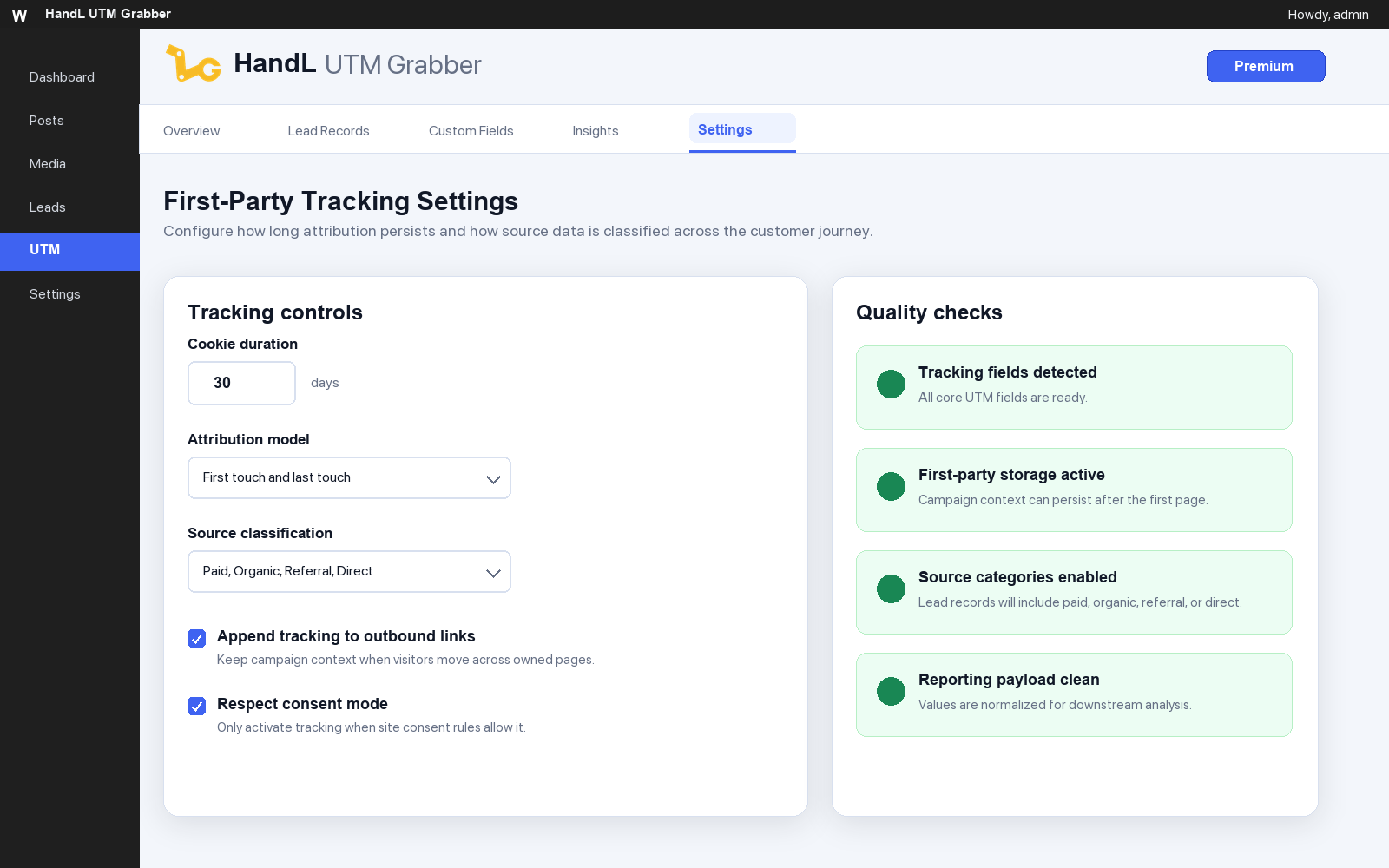
Hidden fields are not the leak
A hidden form field is simply an input that is not displayed to the visitor. It can attach utm_source=google or utm_campaign=brand to a submission so the organization can understand which campaign produced the inquiry.
The hidden field does not decide whether the record leaves WordPress. The form action, CRM integration, email notification, webhook, automation, analytics tag, and server configuration decide that.
Consider two implementations:
Lower-risk first-party attribution
- The page receives neutral UTM values.
- UTM Grabber stores those values in first-party cookies.
- A WordPress form records only approved campaign fields.
- The submission remains in the organization's approved environment or moves to a reviewed CRM.
- Clinical free text is separated from marketing reports.
- No ad pixel receives the form payload.
High-risk outbound disclosure
- A condition-specific URL identifies the service sought.
- The form collects name, email, symptoms, appointment type, and insurance details.
- Google Tag Manager, a session replay script, or a custom event reads the submission.
- A third-party endpoint receives the full URL, form labels, identifiers, and health context.
- The vendor has no valid permission or BAA for the PHI.
Both sites might use hidden fields. Only one architecture creates the unnecessary external disclosure.
Where risk can re-enter an on-premise setup
- Full landing-page URLs can contain sensitive query strings and may be copied into forms, logs, analytics, or CRM records.
- IP addresses and device identifiers can increase identifiability and should not be collected or exported by default without a documented need.
- CRM syncs, Zapier, Make, webhooks, and email notifications create new recipients and new access paths.
- Meta Pixel, Meta CAPI, Google Ads, GA4, session replay, chat, and call-tracking tools can receive page or conversion context independently of UTM Grabber.
- WordPress hosting, backups, security scanners, and support access may create Business Associate obligations if those providers maintain or access ePHI.
- Poorly named campaigns can put a diagnosis, treatment, or appointment intent into URLs before the visitor reaches the site.
- Long retention and broad WordPress administrator access increase exposure even when no external marketing vendor is involved.
The core attribution layer can stay local while another part of the stack quietly exports the same record.
A HIPAA-safe UTM naming policy for healthcare marketing
Healthcare campaign governance should start before the click. Do not put sensitive meaning into a URL and then hope to scrub it later.
Recommended public UTM pattern
utm_source=google
utm_medium=cpc
utm_campaign=service_line_3
utm_content=responsive_search_ad_a
Keep a protected internal lookup table that maps service_line_3 to the business category. Limit access to that dictionary and do not expose patient-level outcomes in it.
Avoid these public values
utm_campaign=opioid_addiction_treatment
utm_term=infertility_diagnosis
utm_content=hiv_patient_retargeting
patient_name=jane_smith
mrn=12345
appointment_id=98765
Even when a particular value does not meet every element of PHI by itself, URLs are poor places for sensitive information. They can appear in browser history, server logs, screenshots, support tickets, analytics payloads, and referrer headers.
Healthcare UTM tracking implementation checklist
Use this checklist for HIPAA-aware WordPress UTM tracking, healthcare lead attribution, and first-party marketing analytics.
- Confirm whether HIPAA applies to the organization and workflow. Not every wellness site is a covered entity, but FTC rules and state privacy laws may still apply.
- Inventory the complete data flow. Include WordPress, hosting, CDN, forms, CRM, email, call tracking, analytics, ad pixels, server-side tags, webhooks, backups, and support tools.
- Create an allowlist for URL parameters. Capture only approved fields such as source, medium, neutral campaign code, content variant, and click ID when justified.
- Ban patient and health details from campaign names. Never place names, email addresses, medical record numbers, appointment IDs, diagnoses, symptoms, medications, or treatment details in a URL.
- Prefer neutral campaign codes. Map the code to a protected internal dictionary instead of exposing a condition or procedure in the public link.
- Store attribution first-party. Keep the core campaign record inside the website owner's controlled WordPress environment rather than automatically copying it to an attribution vendor.
- Map only necessary fields into forms. Most marketing analysis needs
utm_source,utm_medium,utm_campaign, and perhapsutm_content. Full URL and IP address should require a specific, documented justification. - Separate attribution from clinical free text. Marketing teams rarely need symptoms, diagnoses, medication, insurance, or care notes to measure source performance.
- Review every outbound integration. Treat CRM syncs, webhooks, email notifications, ad APIs, analytics tags, and automation platforms as separate disclosures.
- Determine which vendors are Business Associates. Obtain appropriate BAAs before allowing a vendor to create, receive, maintain, or transmit PHI on behalf of the organization.
- Do not treat a cookie banner as HIPAA authorization. HHS explicitly says ordinary accept-or-reject banners are not valid HIPAA authorizations.
- Apply access controls and retention limits. Restrict who can view submissions, log access, remove stale records, secure backups, patch WordPress, and require strong authentication.
- Test with synthetic data. Submit controlled journeys and inspect cookies, browser network requests, form payloads, CRM records, server logs, and ad-platform events.
- Document the risk analysis. HHS requires an accurate and thorough assessment of risks and vulnerabilities to the confidentiality, integrity, and availability of ePHI.
- Re-audit after every site change. A new tag, form, plugin, campaign template, or agency can alter the data flow without changing the visible page.
What good healthcare attribution looks like
- Neutral UTMs identify source, channel, campaign code, and creative.
- First-party cookies preserve attribution across the WordPress journey.
- Approved hidden fields attach campaign context to the organization's own lead record.
- Clinical and patient data remains in the systems designed and governed for it.
- Outbound destinations receive the minimum necessary data, or nothing, based on a documented review.
- BAAs follow actual data access, not blanket assumptions about every installed software package.
- Consent, authorization, security, and retention controls are treated as separate obligations.
- Synthetic end-to-end tests prove what each vendor really receives.
The goal is not to make marketing blind. The goal is to preserve useful attribution without giving unnecessary parties a copy of the patient's story.
What about click IDs such as GCLID and FBCLID?
Click identifiers can be valuable for attribution, but they are still unique codes tied to a browser journey. HHS includes unique identifying codes, IP addresses, device identifiers, and URLs in its tracking-technology discussion. That does not make every click ID PHI in every setting, but it does mean healthcare teams should not treat click IDs as meaningless.
Use click IDs under the same rules:
- capture them only for a defined purpose
- keep them first-party when possible
- apply retention limits
- do not combine them with clinical details in ad-platform payloads
- review offline conversion and audience uploads separately
- avoid sensitive event names, URLs, and custom parameters
For a deeper field-level review of ad APIs, read HIPAA Conversion Tracking: Meta CAPI, Google Ads, and PHI.
Does hashing solve the PHI problem?
No. Hashing is useful for matching, but it is not the same as HIPAA de-identification. A hashed email can still be used by an advertising platform to recognize a person. If the same event reveals a condition, appointment, procedure, prescription, or treatment interest, hashing the email does not remove the meaning of that event.
HHS de-identification guidance lists URLs, IP addresses, email addresses, account numbers, device identifiers, and other unique codes among the identifiers addressed by the Safe Harbor method. De-identification requires a complete method, not one transformed field.
Does HIPAA apply to every healthcare or wellness website?
No. HIPAA applies to covered entities and Business Associates, not to every company that publishes health content or sells a wellness product. HHS says that if an entity does not meet those definitions, it does not have to comply with the HIPAA Rules.
That is not permission to ignore privacy. The FTC Health Breach Notification Rule can apply to certain health apps, websites, and connected products outside HIPAA. The amended rule has applied since July 29, 2024, and state consumer-health privacy laws may impose additional requirements.
Is UTM Grabber "HIPAA compliant"?
No plugin can make that promise for an entire organization. HIPAA compliance belongs to the full system of people, policies, contracts, vendors, safeguards, and data flows.
What UTM Grabber can accurately say is more useful:
- Core attribution capture happens in the customer's WordPress stack.
- The core workflow does not require sending a vendor-side copy to an external attribution SaaS.
- First-party storage gives the website owner direct control over collection, mapping, access, and retention.
- Form and order integrations can preserve attribution without exposing clinical meaning in ad pixels.
- Consent-aware operation is available through WordPress consent integrations.
- Optional outbound features must still be configured and reviewed for the customer's legal and privacy requirements.
This makes UTM Grabber a strong choice for teams seeking HIPAA-aware attribution, privacy-first WordPress analytics, cookieless UTM tracking, and healthcare marketing measurement without introducing an unnecessary third-party attribution database.
Learn more on the HandL UTM Grabber WordPress plugin page, or review our GDPR-compliant UTM tracking guide.
Frequently asked questions
Are UTM parameters considered PHI?
Not automatically. A neutral source or campaign label is not inherently PHI. A UTM value can become part of PHI when it relates to an individual's health or care, identifies or can reasonably identify that person, and is maintained or transmitted in a HIPAA-regulated context.
Can a healthcare website use hidden UTM fields?
Yes, if the organization has reviewed the data flow and safeguards. A hidden field is not an external disclosure by itself. The organization should use neutral values, minimize fields, separate clinical details, secure the resulting record, and review every CRM, webhook, email, analytics, and advertising destination.
Does an on-premise WordPress plugin need a BAA?
Not automatically. HHS says a software vendor is not a Business Associate merely because it provides software when the vendor has no access to PHI. If the vendor hosts, maintains, receives, or accesses PHI to provide the service or support, the relationship must be evaluated and a BAA may be required.
Is first-party tracking always safe under HIPAA?
No. First-party architecture reduces unnecessary disclosures, but the covered entity must still secure ePHI, control access, minimize data, manage retention, assess vendors, and perform risk analysis. First-party is a better boundary, not a substitute for compliance.
Should healthcare marketers remove all tracking?
Usually not. Removing all attribution can make it harder to allocate budgets, detect broken campaigns, and measure outreach. A better approach is data minimization, neutral campaign naming, first-party storage, destination controls, and documented testing.
Can I send UTM data to Meta or Google Ads?
That requires a separate analysis. Generic campaign context is different from sending an identifiable health conversion. Review the event name, source URL, user data, custom data, click IDs, purpose, platform policy, permission, and BAA status before any upload. See our healthcare conversion API guide for details.
The bottom line
The claim that UTM Grabber creates a major HIPAA risk simply by capturing UTMs and placing them in form fields confuses local data use with third-party data disclosure.
The real risk is not the presence of utm_source. It is an identifiable health story leaving the systems authorized to hold it.
UTM Grabber helps reduce that risk because its core attribution workflow can remain inside WordPress. No external attribution vendor needs a copy. Healthcare teams still need careful campaign naming, field minimization, access controls, secure hosting, vendor review, BAAs where applicable, and disciplined outbound integrations.
Keep the campaign label. Keep the patient's story private.
Capture neutral UTMs and click context inside WordPress, then control exactly what moves downstream.
Sources checked
- 45 CFR 160.103: HIPAA definitions
- HHS OCR: Use of Online Tracking Technologies
- HHS: Is a software vendor a Business Associate?
- HHS: Covered Entities and Business Associates
- HHS: Minimum Necessary Requirement
- HHS: Guidance on Risk Analysis
- HHS: Guidance Regarding Methods for De-identification of PHI
- FTC: Health Breach Notification Rule Basics for Business
- HandL UTM Grabber on WordPress.org
This article provides educational information, not legal advice. HIPAA and consumer-health privacy obligations are fact-specific. Work with qualified privacy and security professionals before implementing systems that may create, receive, maintain, transmit, use, or disclose PHI.