
HIPAA Conversion Tracking: Meta CAPI, Google Offline Conversions, and PHI
Healthcare marketers want the same thing every other marketer wants: cleaner attribution, better lead quality, and ad platforms that learn from real outcomes instead of shallow pageviews.
That is why Meta Conversions API, Google Ads offline conversion imports, enhanced conversions, and CRM-based conversion goals are so attractive. They connect the click to the form, the appointment, the consult, the sale, or the downstream lead stage.
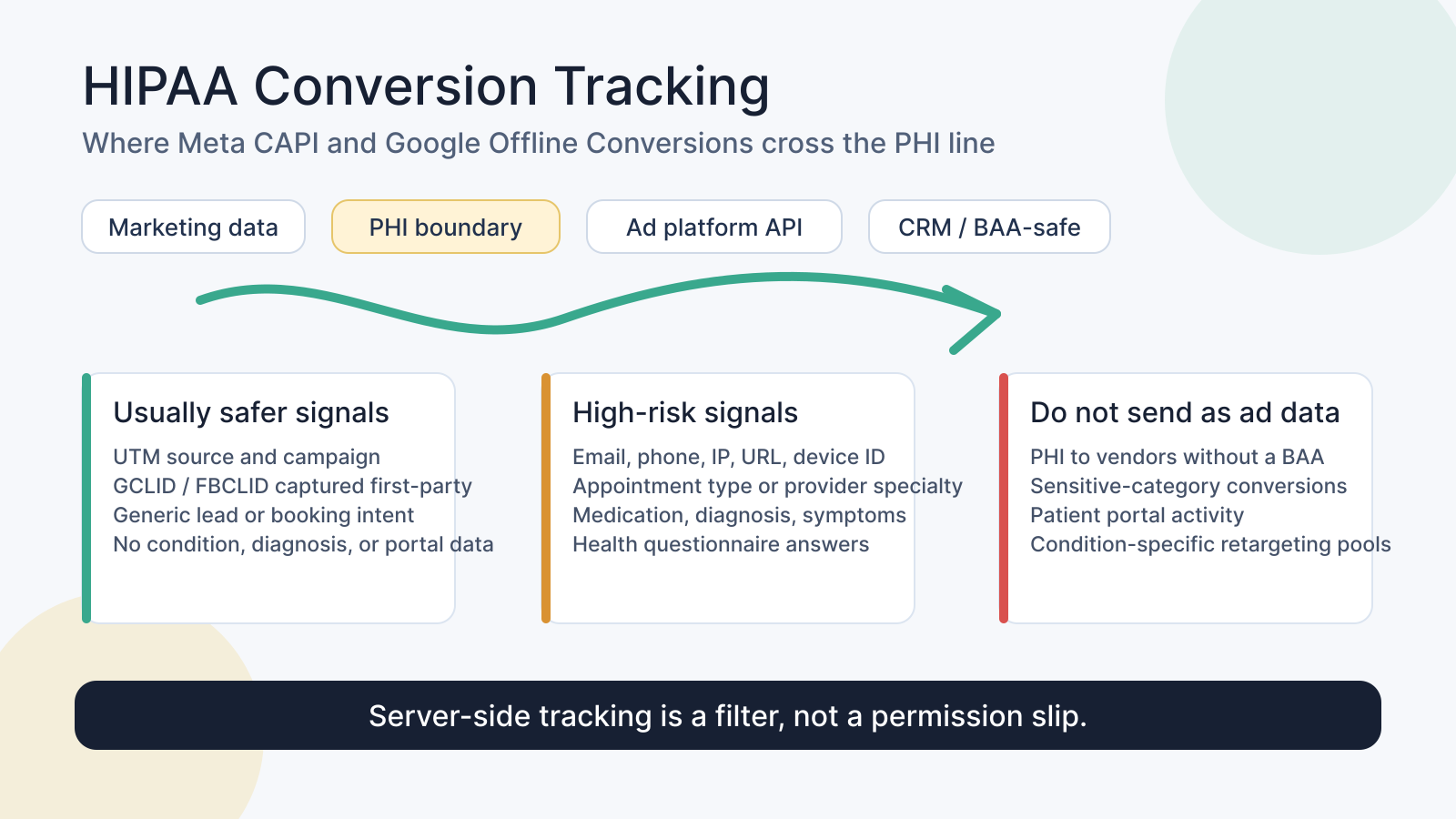
But in healthcare, the payload can cross a line quickly. A hashed email plus a generic lead event is one thing. A hashed email plus a URL, form name, appointment type, medication, diagnosis, provider specialty, or patient portal action is another. Server-side tracking is a filter, not a permission slip.
If this sounds familiar
- You want Meta CAPI or Google offline conversions, but legal is worried about HIPAA.
- Google asks for hashed email, phone, name, or address to improve enhanced conversions.
- Meta Events Manager pushes you toward better match quality and more customer information parameters.
- Your CRM knows whether a lead booked, showed, bought, or became a patient.
- Your landing pages, forms, URLs, or conversion names reveal the service someone needed.
- Nobody can explain exactly where UTM tracking ends and PHI begins.
The goal is not to kill attribution. The goal is to keep clinical facts out of ad-platform pipes.
The line is not the tool. The line is the data.
First: this is not legal advice
This article is an educational risk framework for marketers, operators, and implementation teams. HIPAA analysis is fact-specific. If you are a covered entity, business associate, digital health company, agency, or vendor handling health-related conversion data, involve privacy counsel before sending data to Meta, Google, analytics tools, data warehouses, or server-side tag managers.
What HIPAA actually protects
HIPAA does not treat every word about health as PHI in every possible setting. The core test is context.
Under 45 CFR 160.103, health information relates to health, care, or payment for care. Individually identifiable health information adds an identifier or a reasonable basis to identify the person. PHI, or protected health information, is individually identifiable health information held or transmitted by a covered entity or business associate, with specific exclusions.
That is the core Meta CAPI HIPAA and Google Ads HIPAA issue: the ad API is not the problem by itself. The problem is sending protected health information, or data that reveals health care intent, into a destination that is built for advertising measurement and optimization.
In plain English:
email = jane@example.comis an identifier./oncology-second-opinion/booking-confirmedis health-care context.jane@example.com + oncology booking + IP address + timestampcan become a PHI problem for a regulated healthcare entity.
That is why the same technical field can be harmless in one account and risky in another. A Lead event on a generic B2B SaaS demo page is not the same as a Lead event on a treatment, prescription, fertility, addiction, oncology, weight-loss, or mental-health appointment flow.
HHS has been explicit about tracking technologies
HHS OCR says tracking technologies can collect information such as email address, appointment dates, IP address, geographic location, device IDs, and unique identifying codes. It also says tracking on authenticated pages such as patient portals or telehealth platforms generally has access to PHI.
HHS also gives the practical example that if a covered clinic's website lets a person make an appointment and a third-party tracking technology automatically transmits appointment information and the person's IP address, the tracking vendor may be a business associate and a BAA may be required.
There is nuance. In June 2024, a federal court vacated part of HHS's guidance about an IP address plus a visit to an unauthenticated public health-condition page being enough by itself. But that does not make appointment forms, symptom checkers, login pages, patient portals, mobile health apps, or health questionnaire data safe for ad platforms.
Why Meta CAPI can receive PHI-like data if you are not careful
Meta CAPI is usually implemented to send server events such as Lead, CompleteRegistration, Schedule, InitiateCheckout, or Purchase. A typical event can include:
event_nameevent_timeevent_idevent_source_urlaction_sourceuser_datacustom_dataclient_ip_addressclient_user_agent- hashed email, phone, name, city, state, zip, country, or external ID
- browser identifiers such as
fbpand click identifiers such asfbc
None of those fields is automatically bad. The risk comes from the combination.
Examples that can cross the line:
event_source_url = /anxiety-treatment/book-nowcustom_data.content_name = GLP-1 consultationevent_name = Purchasefor a prescription, device, therapy, fertility, or medical serviceexternal_idthat maps directly to a patient recorduser_datacontaining email, phone, IP, browser ID, and location on a health-specific conversion
Hashing helps match identities. It does not erase the meaning of the event. If the event itself says the person requested addiction treatment, booked a therapy consult, purchased a medical device, or submitted symptoms, hashing the email does not turn the payload into safe marketing data.
Why Google Ads offline conversions and enhanced conversions raise similar issues
Google Ads offline conversion imports are used to send downstream outcomes back to Google Ads. Enhanced conversions for leads can supplement imports with user-provided data such as email address, phone number, name, home address, and GCLID. Google requires normalization and SHA-256 hashing for certain customer fields when uploaded through the API.
That can be useful for ordinary lead generation. It is risky for health conversions.
Google's customer data policies say enhanced conversions, enhanced conversions for leads, and store sales uploads may not include conversion information related to sensitive categories. Google specifically lists health or medical information, including purchases of medical services, prescription drugs, or medical devices.
So there are two separate filters:
- HIPAA and health privacy law may restrict the disclosure.
- Google policy may independently prohibit the measurement use, even if a marketer thinks the data was collected first-party.
That matters because a successful API upload does not equal compliance. An accepted payload can still be unlawful, policy-violating, or unsafe.
Where to draw the practical PHI line
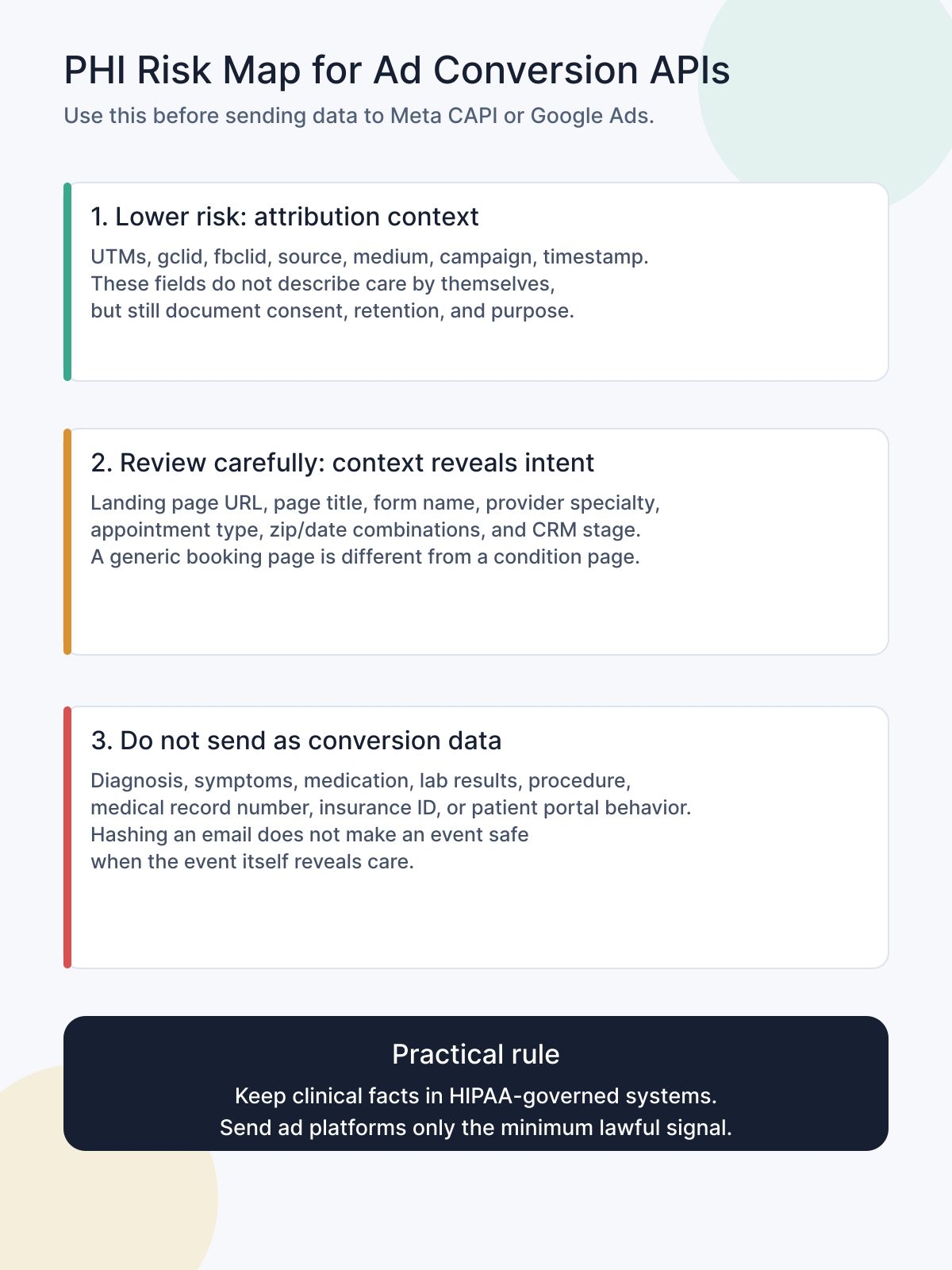
Use this simple framework before you send anything to Meta CAPI, Google Ads API, enhanced conversions, Customer Match, custom conversions, analytics destinations, or a server-side tag manager.
Usually safer: attribution context
These fields are often useful for first-party attribution and do not describe care by themselves:
- UTM source, medium, campaign, term, and content
- landing page ID if it does not reveal a condition or service line
gclid,gbraid,wbraid,fbclid,msclkid- first-touch and last-touch source
- generic conversion timestamp
- generic lead stage such as
lead_submitted - consent state and form source
Even here, keep retention, access, and consent disciplined. "Usually safer" does not mean "ignore privacy."
Review carefully: context that can reveal health intent
These fields can become sensitive when combined with identifiers:
- full page URL
- page title
- form name
- appointment type
- provider specialty
- service line
- product name
- condition-specific campaign name
- CRM lifecycle stage
- zip code plus dates
- referral source from a condition page
Example: utm_campaign=brand_search is different from utm_campaign=ketamine_depression_consult.
Do not send to ad platforms as conversion data
Keep these in HIPAA-governed systems, not ad-platform optimization pipelines:
- diagnosis
- symptoms
- medication or prescription details
- lab results
- procedure names
- medical record number
- health plan beneficiary number
- insurance ID
- patient portal behavior
- appointment date tied to a patient
- free-text health questionnaire answers
- condition-specific purchase details
- reproductive, mental-health, substance-use, fertility, sexual-health, or chronic-condition facts tied to an identifier
If the field would make a reasonable person say, "Now I know something about this person's health or care," do not send it to Meta or Google for ad measurement.
Sources checked:
- 45 CFR 160.103 definitions
- HHS OCR: Use of Online Tracking Technologies
- HHS: HIPAA De-identification Guidance
- HHS: HIPAA Marketing Guidance
- HHS: Business Associates
- Meta Conversions API server event parameters
- Meta Conversions API customer information parameters
- Meta Business Tools Terms
- Google Ads API: Manage Offline Conversions
- Google Ads Customer Data Policies
- Google Ads enhanced conversions for web
- FTC: GoodRx health data enforcement
- FTC: BetterHelp health data order
- FTC: Health Breach Notification Rule guidance
What goes wrong when teams blur the line
- A cookie banner gets mistaken for HIPAA authorization.
- A server-side tag manager forwards the same risky payload faster and more invisibly.
- A conversion name, URL, or custom parameter reveals the condition.
- Hashed customer data is treated as de-identified when it is only pseudonymous matching data.
- Meta or Google receives conversion data tied to medical services, prescriptions, devices, or treatment intent.
- A vendor receives PHI without a BAA or a permitted disclosure path.
- A non-HIPAA health app assumes HIPAA does not apply, then runs into FTC health-privacy enforcement.
Bad healthcare tracking does not just create bad reports. It can create legal, platform, and patient-trust risk.
What good looks like for HIPAA-aware attribution
- Keep Meta Pixel and CAPI off authenticated patient portals and clinical workflows unless counsel has approved the exact design.
- Do not send full health-specific URLs, page titles, form labels, appointment types, or condition names to ad platforms.
- Store UTMs and click IDs first-party in the form, CRM, order, or booking record.
- Use neutral conversion names such as
lead_submittedorbooking_request, notopioid_treatment_booking. - Separate ad-platform optimization signals from clinical, payment, diagnosis, and treatment records.
- Use a BAA-capable CDP, server-side gateway, warehouse, or analytics layer when PHI must be processed.
- Maintain an allowlist of fields that can leave the first-party system and a denylist of fields that never can.
- Document consent, authorization, retention, access controls, and vendor responsibilities.
The safer architecture is boring on purpose: classify, minimize, filter, document, and keep clinical facts in the right systems.
Why more data is not always better
Where UTM Grabber fits
UTM Grabber helps healthcare and health-adjacent teams preserve first-party attribution without forcing PHI into ad-platform payloads.
- Capture UTMs, click IDs, referrers, landing pages, and source history before the form or booking is submitted.
- Store attribution context in hidden fields, CRM records, lead notifications, WooCommerce orders, and internal reports.
- Keep downstream ad uploads simpler by separating campaign context from clinical context.
- Help teams prove which campaigns drove leads without naming the diagnosis, appointment type, or treatment in the ad-platform event.
- Support a cleaner handoff between marketing, compliance, agencies, and revenue teams.
Who should read this before uploading conversions
- Healthcare providers using Meta Pixel, Meta CAPI, Google Ads, GA4, or server-side tracking.
- Clinics, telehealth companies, pharmacies, therapy providers, fertility clinics, weight-loss programs, and med spas.
- Agencies managing paid media for health, wellness, medical, or regulated lead-gen accounts.
- WordPress and WooCommerce teams capturing UTMs, bookings, forms, orders, and CRM stages.
- Digital health apps that may sit outside HIPAA but still handle sensitive consumer health data.
- Compliance teams trying to build a practical field-level review process.
If the conversion tells a health story about an identifiable person, slow down before you send it.
What real users are saying
Capture campaign and click context first-party, then decide what can safely move downstream.