
UTM Source vs Medium - The Confusion That Breaks Most Reports
Source and medium are the most important UTM parameters. They are also the most misunderstood. Most reports show utm_source=google and utm_medium=cpc without anyone knowing why there are two parameters or when to use each. This confusion creates data that looks correct but means nothing.
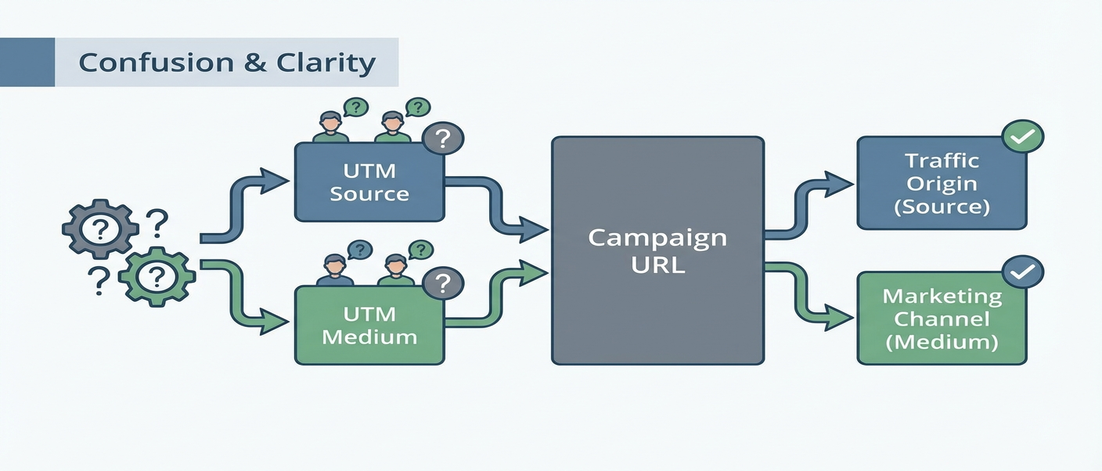
If this sounds familiar, you are not alone
- You use
utm_source=googleandutm_medium=searchbecause you saw it somewhere, not because you understand the relationship - Your reports mix referrer-based sources (facebook, twitter) with platform-based sources (newsletter, partner) and you cannot compare them
- You have
utm_source=email_marketingandutm_medium=newsletterbecause you are not sure which is which - Your agency sends
utm_source=googleandutm_medium=displayand you have no idea if that is correct
Source and medium work together. Using one without the other is like describing a car by only saying it has wheels.
Source and medium work as a pair
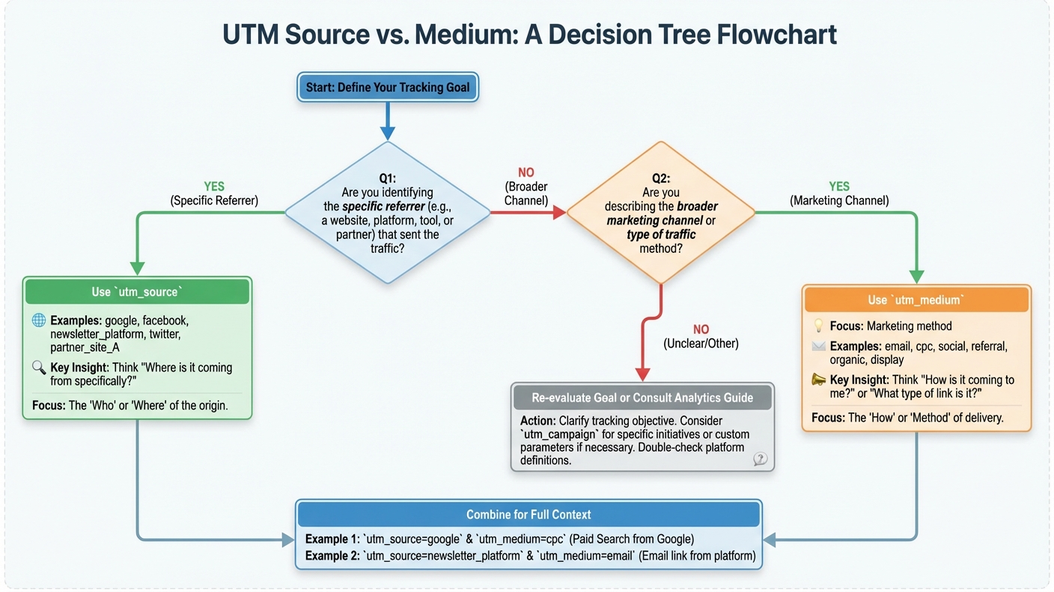
1. Source identifies the referrer
Source tells you which platform or website sent the traffic. Facebook. Google. Newsletter. PartnerSite. It is the who.
Think of source as the entity that sent the visitor. If someone clicked a link on Facebook, source is Facebook.
2. Medium describes the type of traffic
Medium tells you how the source sent the traffic. Cpc. Email. Organic. Referral. Social. It is the how.
Think of medium as the channel type. Facebook can send traffic via different mediums - cpc for ads, referral for shares, social for posts.
3. The combination tells the full story
Source + medium together create meaningful categories. Google + cpc = paid search. Facebook + social = organic social. Newsletter + email = email marketing.
The combination matters. Facebook + cpc is paid advertising. Facebook + referral is word of mouth. Same source, different mediums, completely different attribution.
The real cost is not the confusion - it is broken channel analysis
- Using medium=social with source=google makes paid search look like organic social
- Inconsistent source naming means you cannot aggregate channel performance
- Mixing referrer-based and platform-based sources creates comparison problems
- Wrong combinations make your entire traffic analysis unreliable
Wrong source/medium combinations make it impossible to understand which channels actually work.
What correct source/medium usage looks like
- Source is always a specific platform or referrer (Facebook, Google, Newsletter)
- Medium is always a traffic type (cpc, email, organic, referral, social)
- Every combination tells you exactly what happened
- You can aggregate by source, by medium, or by both
Good source/medium pairs tell a story. You can read a report and understand exactly where traffic came from.
Why guessing does not work
This is exactly why we built UTM Grabber
UTM Grabber enforces correct source/medium pairs - so your traffic analysis actually means something.
- Pre-defined source/medium combinations that make sense
- Validation that prevents impossible or misleading pairs
- Automatic correction of common mistakes
- Consistent tracking across your entire organization
UTM Grabber is built for teams who need reliable channel data
- Marketing teams whose channel reports do not make sense
- Agencies managing multiple clients with different tracking needs
- Anyone who has ever looked at a report and wondered why numbers do not add up
- Teams comparing channel performance across time periods
If you want to know which channels work, this is for you.