Last-Click Attribution - Why Giving All Credit to the Last Touch Ruins Your Marketing
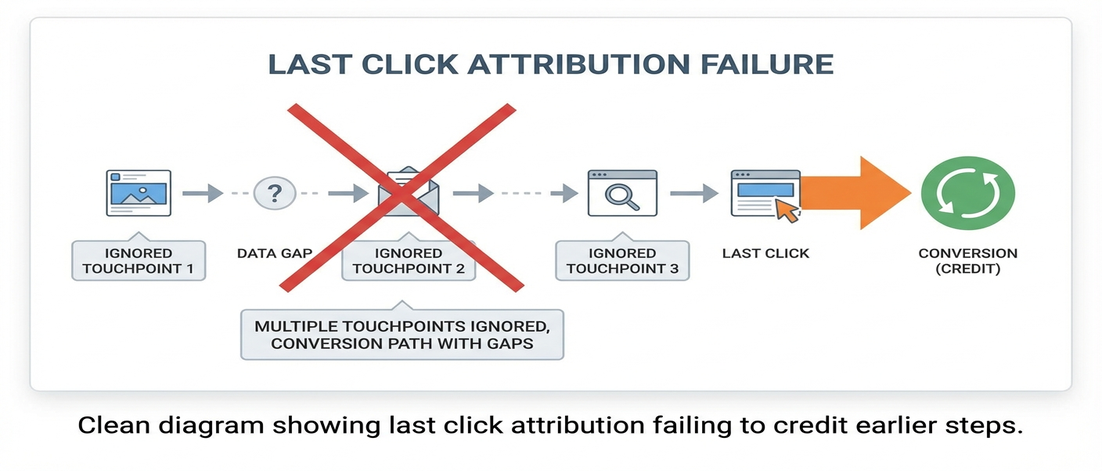
Someone discovers your brand through a blog post. Reads three case studies. Clicks a Facebook ad. Sees a retargeting banner. Converts. Last-click attribution gives all credit to the banner ad. The blog post, case studies, and Facebook ad get nothing. This is not just unfair. It is wrong. And it is destroying your marketing decisions.
If this sounds familiar, you are not alone
- Your content marketing shows zero conversions even though it drives the initial interest
- You kill top-of-funnel campaigns because they show no conversions
- You scale retargeting budgets while brand awareness decays
- Your team argues about channel value because the data tells different stories
- You cannot prove the value of anything except the final touchpoint
Last-click is simple. Simple is wrong.
Why last-click attribution fails modern customer journeys
1. Customer journeys have multiple touchpoints
Modern buyers interact with 6-10 pieces of content before converting. They discover, research, compare, and reconsider. Last-click ignores all of that except the final click.
Attribution that ignores 80% of the customer journey cannot tell you what actually works.
2. Last-click punishes long consideration cycles
B2B sales take 30-90 days. Complex purchases take even longer. Last-click attribution expires before conversion for these buyers. Every long-cycle prospect shows as direct traffic, making your top-of-funnel look ineffective.
Last-click works for impulse purchases. It fails for everything else.
3. Last-click overvalues retargeting
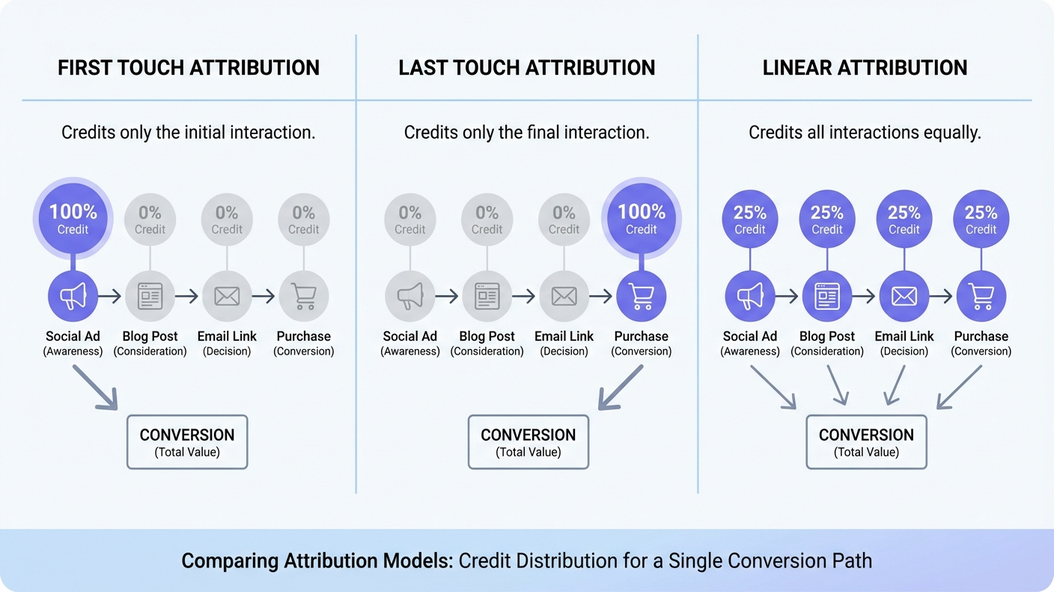
Retargeting reaches people who already know you. They convert faster. Last-click gives retargeting all the credit even though it only finished what other channels started.
You scale retargeting, cut brand, and wonder why overall performance drops.
4. First-click has the same problem
First-click attribution has the opposite bias. It gives all credit to the discovery channel and ignores everything else. Same problem, different end of the funnel.
You need attribution that accounts for the full journey.
The real cost is not bad credit - it is bad strategy
- You cut brand marketing because it shows no conversions
- You over-invest in bottom-funnel channels that only work because of top-funnel
- Your content marketing budget gets cut despite driving qualified leads
- Your marketing becomes increasingly bottom-funnel and fragile
When you optimize for last-click, you optimize away everything that does not close.
What attribution that actually works looks like
- Content marketing shows its role in driving qualified prospects
- You can compare channel value fairly across the funnel
- Your budget allocation reflects actual customer journeys
- You invest in brand without fearing the attribution black hole
Good attribution shows you the full picture. You see how every touchpoint contributes to the whole.
Why more last-click optimization does not help
This is exactly why we built UTM Grabber
UTM Grabber captures the full journey so you can understand real attribution, not just last-click.
- Full journey tracking that survives cookie expiration
- Server-side data that captures what last-click misses
- Integration with multi-touch attribution models
- Reports that show the full picture, not just the last touch
UTM Grabber is built for teams who need real attribution
- Teams with long sales cycles that last-click kills
- Content marketing teams showing zero value
- Brands investing in awareness that never converts in last-click
- Anyone whose marketing optimization is based on incomplete data
If last-click is making you cut effective marketing, this is for you.