
Gravity Forms Lead Attribution From First Click to Closed Revenue
Separate acquisition context from recency context so pipeline and revenue reports stay decision-grade.

If this sounds familiar
- First-touch source gets overwritten by later interactions.
- Opportunity-level reporting cannot trace back to acquisition campaign.
- Attribution analysis depends on manual spreadsheet joins.
- Sales teams do not see meaningful source context in lead records.
- Budget planning relies on conflicting attribution views.
These are fixable implementation issues, not random analytics noise.
Lead attribution architecture for Gravity Forms teams
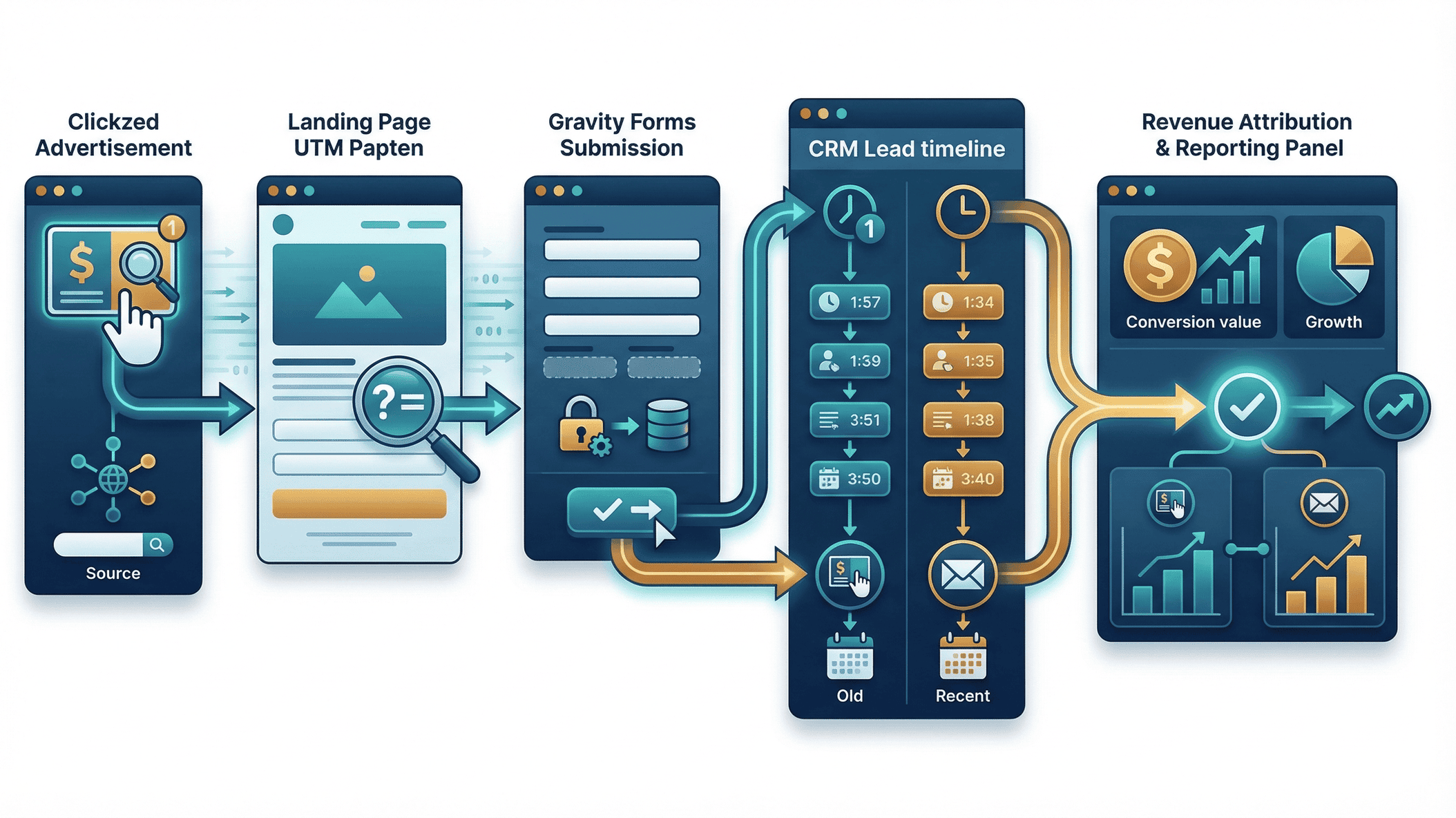
Model attribution as a ledger, not a single field
Keep two explicit records:
- Acquisition ledger (
first_touch_*): immutable. - Interaction ledger (
latest_touch_*): mutable.
Copy rules into opportunity objects
At opportunity creation, copy acquisition fields from lead so revenue reporting does not depend on mutable contact fields.
Cohort QA you can run weekly
- Create two test journeys for same email across different channels.
- Verify first-touch remains fixed.
- Verify latest-touch updates.
- Verify opportunity inherits first-touch on creation.
Related reading:
- First-Touch vs Last-Touch Attribution - UTM Grabber
- Attribution Models Explained - UTM Grabber
- Last-Click Attribution Problems - UTM Grabber
What this costs when left unresolved
- Channel ROI appears to move without real performance changes.
- Pipeline forecasts by source become unstable.
- Decision cycles slow because teams do not trust the data.
If lead attribution fields are mutable by default, revenue reporting drifts as the record ages.
What good looks like in practice
- Acquisition and recency are both visible and intentionally modeled.
- Opportunity reporting remains stable over time.
- Growth decisions use consistent source-of-truth fields.
When source data is stable, optimization speed improves immediately.
Why this stays broken for many teams
This is exactly why we built UTM Grabber
UTM Grabber keeps first-touch and latest-touch states explicit across lead and opportunity lifecycle stages.
- Dual-ledger attribution design.
- Write-once acquisition protection.
- Reliable source-to-revenue visibility.
Who this implementation is for
- RevOps teams running lead-to-opportunity attribution.
- Growth teams allocating budget by pipeline quality.
- Agencies proving channel impact beyond form submits.
If attribution quality affects how you allocate budget, this is the right workflow.
What real users are saying
/#schedule-demo Use your current CRM and form stack.