
CCPA-Safe Gravity Forms Tracking With Usable Attribution
You can keep practical channel insights without violating consent expectations.

If this sounds familiar
- Consent is captured but ignored by downstream automation.
- Attribution fields are stored without clear retention boundaries.
- Opt-out records still flow into marketing audiences.
- Legal and growth teams use different data definitions.
- Reporting drops after consent changes and nobody can explain why.
These are fixable implementation issues, not random analytics noise.
Consent-first attribution design for Gravity Forms
Build the decision tree first
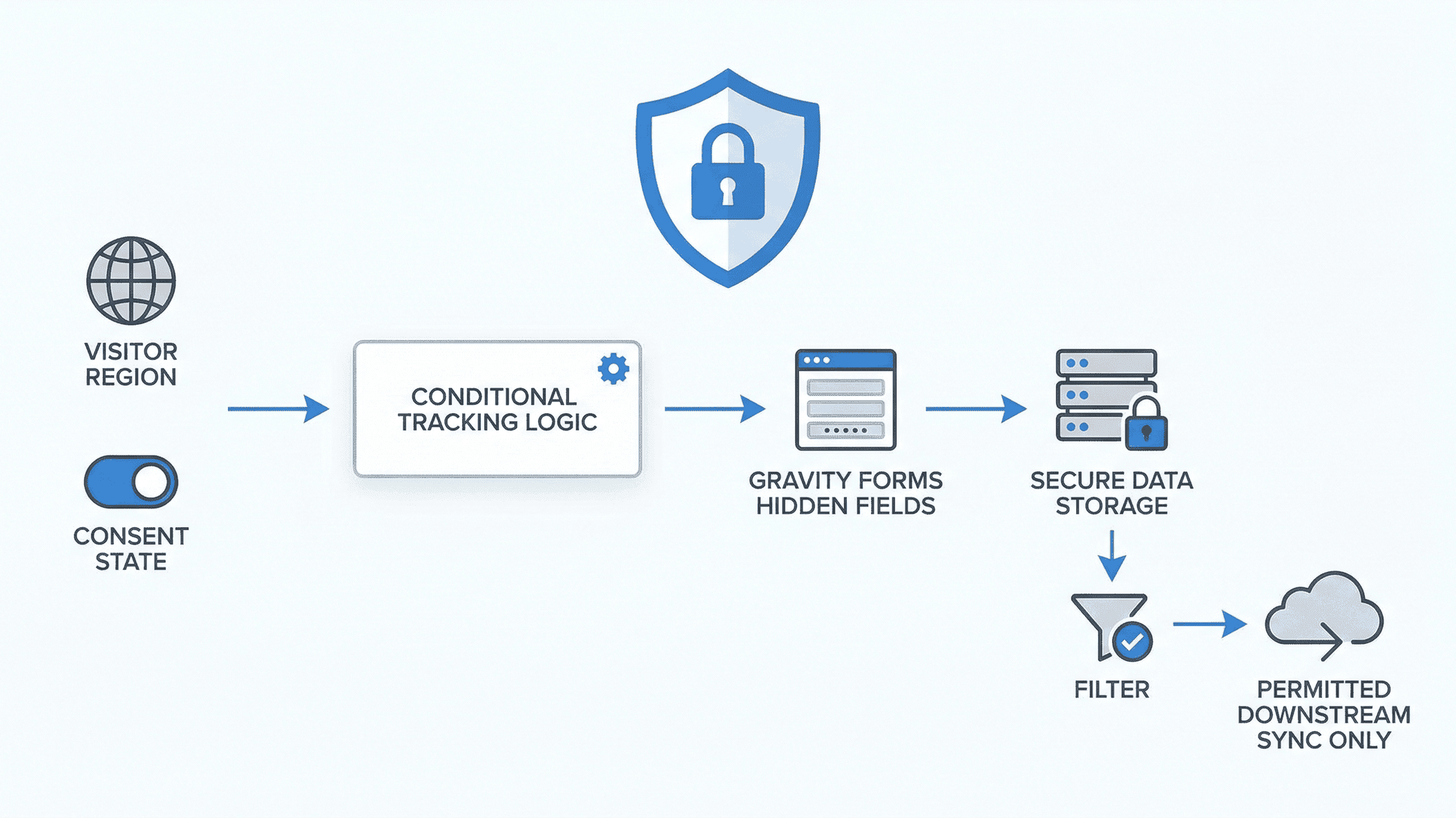
At submit time, decide routing by consent state:
- Consent allowed -> store operational attribution fields.
- Consent restricted -> store only minimum required operational metadata.
- Opt-out -> suppress downstream marketing sync.
Keep compliance fields explicit
Track these alongside source fields:
consent_stateconsent_captured_atconsent_policy_version
Audit scenario table
Test three cases every release: allow, deny, and changed-after-submit.
Related reading:
- GDPR Compliant UTM Tracking - UTM Grabber
- UTM Tracking Without Third-Party Cookies - UTM Grabber
- Why Attribution Breaks - UTM Grabber
What this costs when left unresolved
- Paid optimization slows when compliant data paths are not defined.
- Audit prep consumes ops time that should go to growth.
- Trust between legal and marketing teams erodes.
Compliance mistakes can force retroactive cleanup and disable useful reporting for months.
What good looks like in practice
- Consent state and attribution data are modeled together.
- Opt-out behavior is enforceable across systems.
- Channel reporting remains useful within policy boundaries.
When source data is stable, optimization speed improves immediately.
Why this stays broken for many teams
This is exactly why we built UTM Grabber
UTM Grabber helps teams maintain policy-aware attribution flows without turning analytics into guesswork.
- Consent-aware routing patterns.
- Clear field taxonomy for audits.
- Operational reporting that respects policy constraints.
Who this implementation is for
- Privacy-conscious marketing teams.
- RevOps working with regulated lead flows.
- Organizations balancing growth and compliance.
If attribution quality affects how you allocate budget, this is the right workflow.
What real users are saying
/#schedule-demo Protect reporting and compliance at the same time.