
Forminator Form Tracking That Holds Up Under Cache and AJAX
Forminator can capture clean source data, but only when query handling and integration mapping are engineered together.

If this sounds familiar
- Attribution fields work in staging and fail in production.
- AJAX forms submit while hidden source values disappear intermittently.
- Notification data and webhook data disagree for the same entry.
- Different forms evolved different field names for the same concept.
- Marketing reports require constant manual normalization.
These are fixable implementation issues, not random analytics noise.
How to make Forminator attribution resilient
Build a single field contract first
Define one schema and enforce it across every form:
attribution_sourceattribution_mediumattribution_campaign
Then validate each handoff
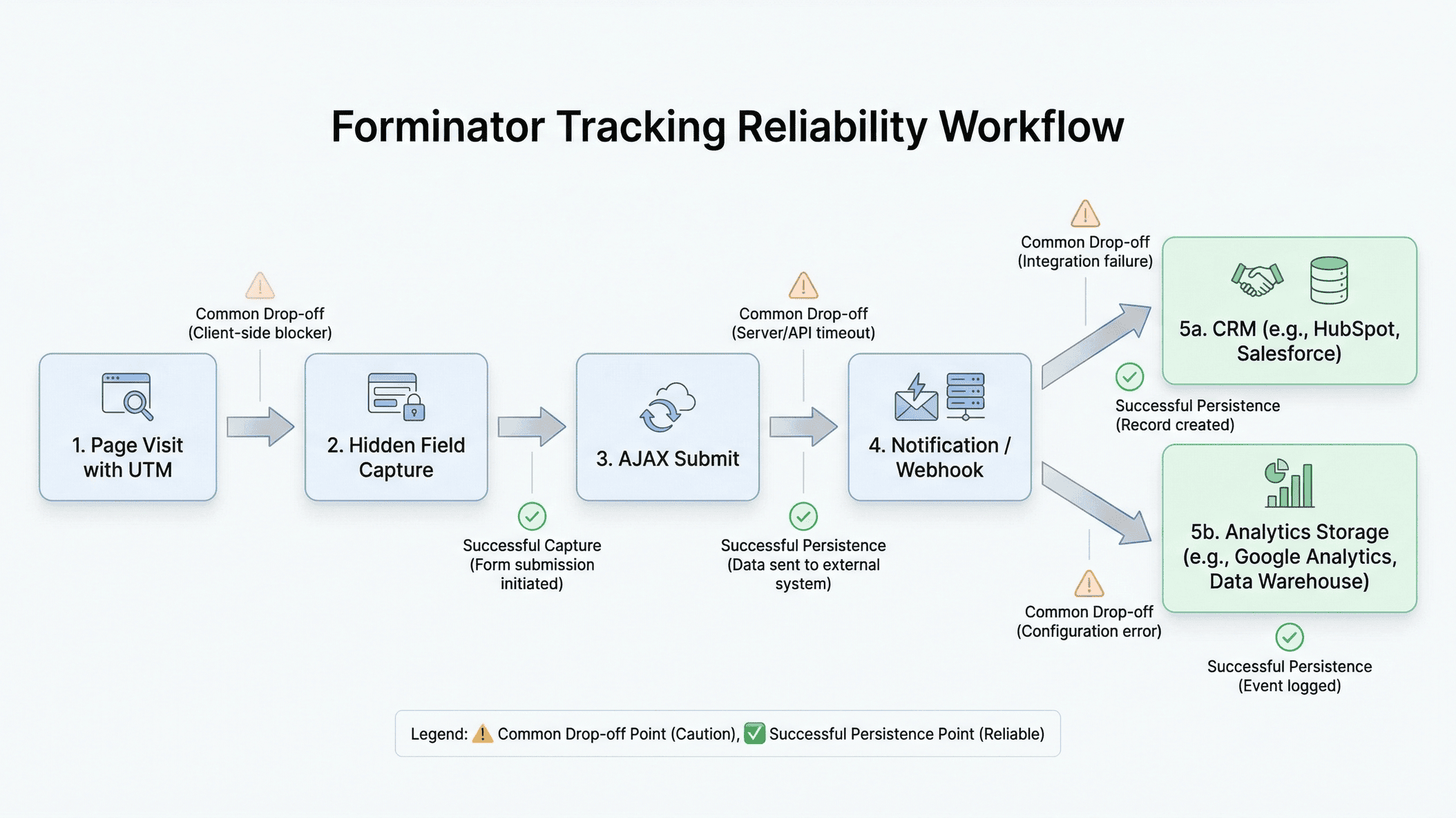
Forminator attribution should be tested at four checkpoints:
- Page load (query params present)
- Pre-submit (hidden fields populated)
- Entry record (stored values)
- Integration payload (mapped values)
Common WordPress trap
Performance plugins can alter URL behavior. Test with optimization layers disabled to isolate capture bugs.
Related reading:
- WordPress UTM Tracking - Why Your Plugin Is Not Enough - UTM Grabber
- UTM Tracking Best Practices - UTM Grabber
- First-Touch vs Last-Touch Attribution - UTM Grabber
What this costs when left unresolved
- Source-level CAC calculations become less reliable every month.
- Campaign experiments are judged on noisy attribution data.
- Team confidence in analytics outputs declines.
Small inconsistencies across many forms create large reporting drift over time.
What good looks like in practice
- All forms emit the same attribution schema.
- AJAX and non-AJAX flows produce identical source fields.
- CRM and analytics pipelines ingest consistent values.
When source data is stable, optimization speed improves immediately.
Why this stays broken for many teams
This is exactly why we built UTM Grabber
UTM Grabber gives Forminator teams a stable schema and QA rhythm so attribution stays clean as forms scale.
- Schema-first implementation approach.
- Checkpoint-based QA for quick root-cause isolation.
- Consistent mapping from entry to CRM.
Who this implementation is for
- WordPress marketers with multiple lead forms.
- Ops teams maintaining CRM data quality.
- Agencies managing many client form stacks.
If attribution quality affects how you allocate budget, this is the right workflow.
What real users are saying
/#schedule-demo Start with your highest-volume form.