
Calendly UTM Tracking That Survives Embed and Routing Handoffs
If campaign data breaks between landing page and booked event, your revenue reporting is guessing.

If this sounds familiar
- Your ad click has UTMs, but booked events in CRM show unknown source.
- Team routing pages or round-robin links strip parameters before the scheduler loads.
- Meeting reminders and webhooks use different payload shapes, so source fields go missing.
- Repeat bookings overwrite original acquisition channel and inflate retargeting performance.
- Pipeline reporting says one thing while paid media reports say another.
These are fixable implementation issues, not random analytics noise.
Calendly-specific failure modes and the implementation pattern that works
1) Embed handoff is where most teams lose attribution
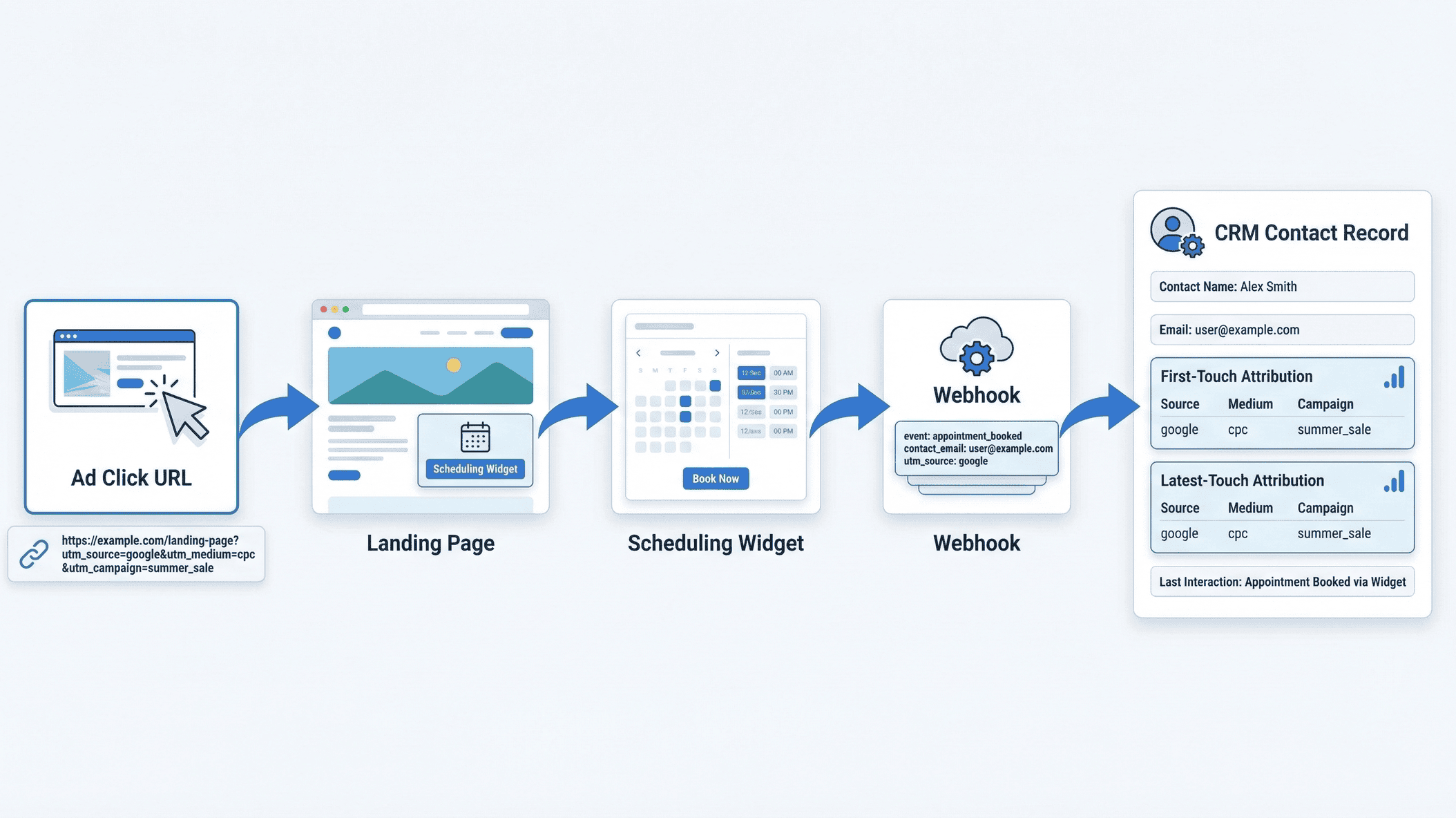
The critical moment is not form submit. It is the URL state before the Calendly widget initializes.
If your site redirects, rewrites, or opens a routing page first, persist utm_source, utm_medium, and utm_campaign into first-party storage before loading the scheduler.
2) Treat first-touch and latest-touch as different jobs
- First-touch: immutable acquisition context.
- Latest-touch: recency context for re-engagement analysis.
Do not map both into one CRM field.
3) Minimal mapping spec for ops
landing.utm_source -> contact.first_touch_source(write-once)landing.utm_campaign -> contact.first_touch_campaign(write-once)calendly.payload.utm_source -> contact.latest_touch_source(update)calendly.event_uri -> contact.last_booking_event_id(dedupe)
4) Fast QA runbook
- Open a tagged URL and confirm params exist before widget load.
- Book twice from different channels for one email.
- Verify first-touch is unchanged and latest-touch updates.
- Compare CRM event log against ad click logs.
Related reading:
- First-Touch vs Last-Touch Attribution - UTM Grabber
- Attribution Models Explained - UTM Grabber
- Why Attribution Breaks - UTM Grabber
What this costs when left unresolved
- Sales velocity analysis gets skewed because source history is incomplete.
- Winning campaigns appear average because meetings are misattributed.
- Forecasting quality drops when pipeline by channel is not trustworthy.
Calendar attribution errors look small but they compound into bad channel budgets.
What good looks like in practice
- Every booking carries consistent source context into CRM.
- Revenue analysis can split acquisition vs re-engagement cleanly.
- Weekly QA catches breakage before budget decisions are made.
When source data is stable, optimization speed improves immediately.
Why this stays broken for many teams
This is exactly why we built UTM Grabber
UTM Grabber keeps campaign fields intact from landing through booked-event sync, including first-touch vs latest-touch separation.
- Capture happens before fragile handoffs.
- Field naming stays consistent across forms and calendar events.
- CRM mappings are built for write-once plus recency updates.
Who this implementation is for
- RevOps teams owning meeting-to-revenue attribution.
- Paid media teams optimizing booked pipeline, not just clicks.
- Agencies handling high-volume lead routing flows.
If attribution quality affects how you allocate budget, this is the right workflow.
What real users are saying
No rebuild required. Start with one form and one pipeline.