
Attribution Models Explained - Which One Should You Actually Use
First-click. Last-click. Linear. Time-decay. Position-based. Data-driven. There are more attribution models than you can count. Every analytics tool defaults to something different. Your agency swears by one, your CFO wants another, and nobody can explain the difference. Here is a practical guide to understanding what each model does and which one fits your business.

If this sounds familiar, you are not alone
- Your analytics shows different conversion numbers depending on which model you select
- Your agency recommends one model but you cannot explain why
- You have no idea what model GA4 is using by default
- Different tools show different attribution and you cannot figure out which is right
- Your leadership asks about attribution and you realize you have been guessing
Every model tells a different story. You need to know which story is true.
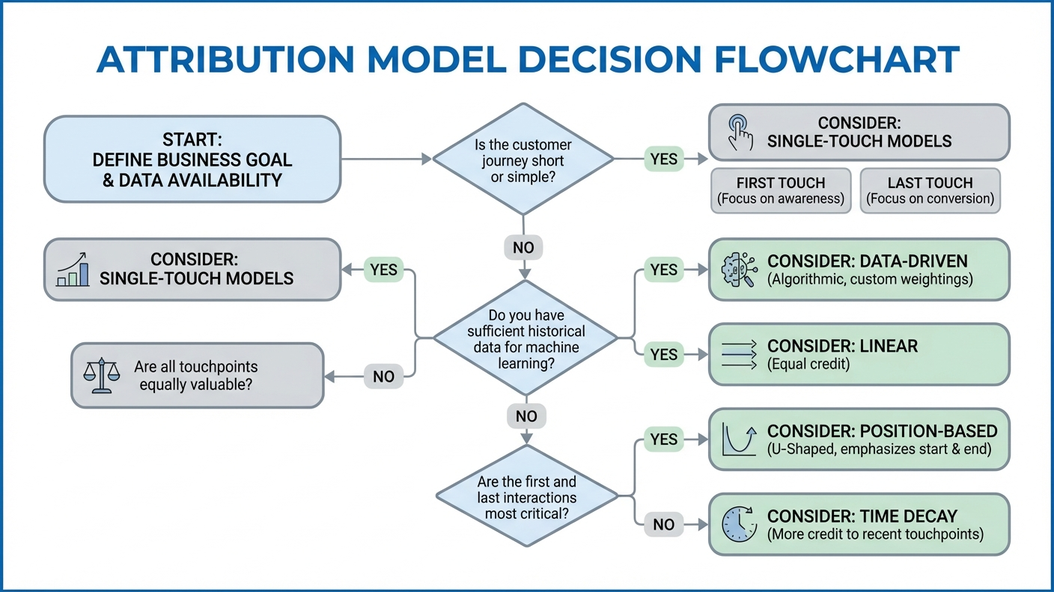
The main attribution models and what they actually do
1. Last-click - All credit to the final touch
Last-click gives 100% of conversion credit to the last interaction before purchase. Simple to understand, simple to report.
Best for: Simple sales with short consideration cycles. Direct response campaigns.
Problems: Ignores everything except the closing touch. Makes top-of-funnel marketing look ineffective.
2. First-click - All credit to the discovery
First-click gives 100% of credit to the first interaction. Shows you what initially captured attention.
Best for: Understanding acquisition channels. Content marketing that drives discovery.
Problems: Ignores everything except the first touch. Makes nurturing and retargeting look ineffective.
3. Linear - Equal credit everywhere
Linear attribution divides credit equally across all touchpoints. Every interaction gets the same weight.
Best for: Long sales cycles with many required interactions. B2B with defined stages.
Problems: Does not recognize that some interactions matter more than others.
4. Time-decay - More credit to recent touches
Time-decay gives more credit to interactions closer to conversion. Earlier touches still get something, but recent touches get more.
Best for: Complex B2B sales. Short consideration cycles where recency matters.
Problems: Can still undervalue top-of-funnel activities.
5. Position-based - Ends get more credit
Position-based gives 40% to first touch, 40% to last touch, and splits the remaining 20% in the middle. Values discovery and conversion, acknowledges middle interactions.
Best for: Marketing that needs both acquisition and conversion credit. Balanced funnels.
Problems: Arbitrary percentages may not match your actual journey.
The real cost is not choosing wrong - it is not choosing at all
- You optimize for a model you do not understand
- Your team debates attribution without shared vocabulary
- Different tools use different defaults, creating conflicting data
- Leadership questions your numbers because you cannot explain the model
Default attribution is someone else is decision. Make it yours.
What choosing an attribution model actually means
- You can explain which model you use and why
- Your team uses the same model across all tools
- Your model matches your actual customer journey
- You can defend your attribution decisions
The right model is the one that matches how your customers actually buy.
Why avoiding the choice does not work
This is exactly why we built UTM Grabber
UTM Grabber helps you choose and implement the right attribution model for your business.
- Attribution model guidance based on your sales cycle
- Consistent tracking across all attribution models
- Tools to compare model outputs
- Integration with GA4 attribution settings
UTM Grabber is built for teams who need clear attribution
- Teams whose analytics default to unclear attribution settings
- Marketing leaders who need to explain attribution to leadership
- Anyone whose tools show different numbers in different models
- Teams transitioning between attribution approaches
If you cannot explain your attribution model, this is for you.